

Board Performance · 2025
In this section15 topics
- Compliance Monitoring — Overview1 item
- Prevention of Conflicts of Interest4 items
- Prevention of the Use of Inside Information3 items
- Anti-Corruption5 items
- Whistleblowing5 items
- Selection of Directors & Chief Executives8 items
- Selection of Independent Directors2 items
- Director Development2 items
- Evaluation of Board & Subcommittee Performance3 items
- Subcommittees1 item
- Meeting Attendance & Remuneration4 items
- Supervision of Subsidiaries & Associated Companies4 items
- Board Duty Performance — Overview1 item
- Audit Committee Duty Performance1 item
- Executive Committee Duty Performance1 item
Compliance Monitoring — Overview
Compliance Monitoring — Introduction
The Board of Directors has established the Company's good corporate governance policy in writing, to serve as a framework for governance and operations for directors, executives, and employees at all levels. The policy is regularly reviewed and updated annually to align with the business environment, best practices, and current changes.
This policy covers key principles, from the structure, roles, duties, and responsibilities of the Board of Directors, as well as guidelines for executive management to be transparent, clear, and auditable. This serves as a guideline for efficient organizational management, building confidence that the Company's business operations are conducted fairly and consider the best interests of shareholders and all stakeholders.
The Company has stipulated that the corporate governance policy and practices be communicated, disseminated, and understood by directors, executives, and employees at all levels comprehensively, to ensure concrete implementation. It is considered a shared responsibility of everyone in the organization to oversee and monitor continuous compliance with the said policy.
Prevention of Conflicts of Interest
Introduction
The Company recognizes the importance of conducting business with honesty, integrity, transparency, and accountability, which are principles of good corporate governance and enhance organizational efficiency. Therefore, the Company has established a policy requiring directors, executives, and employees to avoid any actions that may conflict with the Company's interests, which may arise from interactions with the Company's business partners such as customers, trade partners, etc., using the Company's opportunities or inside information for personal gain, engaging in transactions with the Company, and conducting businesses that compete with the Company, all of which could result in detriment to the Company.
In cases where such transactions are necessary and unavoidable, the Company shall ensure that they are conducted with transparency and fairness, as if transacting with general external parties, taking into account the Company's best interests and fairness to all stakeholders, in order to prevent conflicts of interest. To be adopted as a guideline as follows:
-
The Company shall not provide loans or guarantees to directors or to entities in which directors hold more than 50% of the shares, unless it is part of the Company's welfare benefits.
-
Directors must not engage in businesses that compete with the Company, unless approved by the shareholders' meeting prior to their appointment as directors.
-
Directors and executives must not use the Company's opportunities or information to benefit themselves or others, including engaging in businesses that compete with the Company or related businesses.
-
Directors and executives must not participate in meetings or abstain from voting on items related to themselves that may create a conflict of interest with the Company. If such a transaction is necessary for the Company's benefit, it must be conducted as if it were with an external party (Arm’s Length Basis).
-
Directors must inform the Company of their interests in any contracts entered into by the Company.
-
Directors and executives must prepare a report disclosing conflicts of interest annually or when such events occur.
-
Transactions such as the purchase or sale of assets, etc., between directors and the Company must be reported to and approved by the Board of Directors in advance.
-
The consideration of matters involving conflicts of interest and transactions that may involve conflicts of interest must always include independent directors in the meeting and deliberation.
-
Directors, executives, and personnel of the Company who have access to inside information should avoid using such information for their own benefit or disclosing it to others for improper gain.
Has the Company Acted to Prevent Conflicts of Interest?
Yes
Operations in the Past Year
In 2025, the Company continuously implemented measures to prevent conflicts of interest, with key actions as follows:
Enhancing Knowledge and Awareness among Employees
The Company has communicated and monitored all levels of employees to review their knowledge and complete annual tests to enhance their understanding of the conflict of interest policy and to ensure its correct implementation, in line with good corporate governance principles. This helps employees recognize their duties, responsibilities, and perform their work with the Company's best interests as a priority.
Disclosure of Interests of Directors and Executives
The Company requires directors and executives to prepare and submit declarations of interest in accordance with legal requirements, and to report to the Company whenever there is a change. The Company Secretary is responsible for compiling and submitting copies of these reports to the Chairman of the Board and the Chairman of the Audit Committee for their information and oversight.
Oversight of Connected Transactions
The Company has established strict control and oversight processes for transactions between the Company and related persons or entities, in accordance with the regulations of the Securities and Exchange Commission (SEC) and the Stock Exchange of Thailand (SET), to ensure that such transactions are transparent, fair, and consider the best interests of the Company and its shareholders as a whole.
Oversight of Inside Information Usage and Securities Trading
The Company Secretary has communicated and sent emails to inform directors, executives, and employees with access to inside information, including their spouses and minor children, to be aware of and comply with the guidelines for refraining from buying, selling, transferring, or receiving transfers of the Company's securities in advance, at least one month before the financial statement announcement period, prior to the public disclosure of financial information every quarter, in accordance with relevant practices and regulations, to prevent the misuse of inside information and to build confidence among investors and stakeholders.
Reporting of Securities Holdings
The Company Secretary has prepared a summary report of securities holdings by directors and executives for presentation to the Board of Directors' meeting on a quarterly basis.
Maintaining Confidentiality of Important Information
The Company has overseen that executives, employees, and external parties involved in ongoing projects and/or information not yet disclosed to the public must sign a Non-Disclosure Agreement (NDA) for every project and in all cases, to ensure caution in using significant information and to prevent the disclosure of the Company's confidential information to unauthorized persons.
Monitoring and Evaluation of Compliance with the Prevention of Conflict of Interest
In 2025, there were no cases where directors, executives, or employees of the Company traded securities using inside information. No violations of the securities trading regulations prescribed by the Securities and Exchange Commission (SEC) were identified. In addition, the Company did not receive any complaints regarding the misuse of inside information for improper personal gain.
Number of Conflict-of-Interest Cases
| Metric | Current Year | Previous Year | Two Years Ago |
|---|---|---|---|
| Total number of cases or issues related to conflicts of interest (cases) | 0 | 0 | 0 |
Prevention of the Use of Inside Information
Has the Company Acted to Prevent the Use of Inside Information?
Yes
Operations in the Past Year
The Board of Directors oversees the use of inside information to ensure compliance with laws and good corporate governance principles. This is formally documented in the policy for preventing and managing the use of the Company's inside information for personal gain, to prevent the use of information for trading the Company's securities or for undue advantage. The following actions have been taken:
-
Provide knowledge to directors and various departmental executives regarding their duty to report their holdings of securities or derivatives, as well as those of persons related to directors and executives, to the Office of the Securities and Exchange Commission and the Stock Exchange of Thailand, in accordance with Section 59 and the penalties stipulated in Section 275 of the Securities and Exchange Act B.E. 2535 (1992). Persons related to directors and executives, as defined by the Notification of the Office of the Securities and Exchange Commission No. Sor Jor 38/2561, are as follows:
-
Spouse or cohabiting partner
-
Minor children
-
A juristic person in which oneself, persons under (1), and persons under (2) collectively hold more than 30 percent of the total voting rights of such juristic person, and such collective shareholding constitutes the largest proportion in that juristic person.
-
-
Directors and executives, as well as persons related to directors and executives, are required to report changes in their holdings of securities and derivatives to the Office of the Securities and Exchange Commission in accordance with Section 59 of the Securities and Exchange Act B.E. 2535 (1992) within 3 business days from the date of the change, and to submit a copy of this report to the Company on the same day the report is submitted to the Office of the Securities and Exchange Commission of Thailand.
-
Directors, executives, employees, and staff of the Company who have access to material inside information that may affect securities prices are prohibited from using such inside information to buy, sell, transfer, or accept the transfer of the Company's securities or derivatives before such information is widely disseminated to the general public, especially during the 30-day period prior to the public disclosure of the Company's financial statements or information affecting securities prices. Furthermore, after the information has been disclosed, such individuals are prohibited from buying, selling, transferring, or accepting the transfer of the Company's securities or derivatives until the public who has received such information has had a reasonable time to evaluate the information (at least 24 hours from the date and time of disclosure). Those involved with inside information must not disclose that information to others until it has been reported to the Stock Exchange.
-
Directors, executives, employees of the Company, and individuals with access to inside information are prohibited from disclosing or transmitting inside information or Company secrets to unrelated persons, including family members, relatives, friends, etc.
-
The Company prioritizes preventing the use of inside information for undue personal gain, to the detriment of the Company's interests, or to create conflicts of interest. This is stipulated in the Good Corporate Governance Policy, Code of Conduct and Work Practices, employment contracts, and work regulations.
-
The Company places importance on maintaining the confidentiality of customer information and refrains from using such information for the benefit of directors, executives, employees, and related persons, unless the information is required to be disclosed by law.
-
Information disclosure must be carried out by executives or Company employees authorized to disclose it. General employees who are not authorized to disclose information, when asked to disclose information they are not authorized to disclose, should advise the inquirer to contact the person responsible for disclosing that information to ensure accuracy and consistency of information provided.
-
Not to provide advice or guidance on the trading of the Company's securities, unless it is related to job duties assigned by the Company.
-
The Company places importance on maintaining the security of information in its information systems by controlling and/or preventing unauthorized access to Company data by external parties, and by assigning data access rights to employees at various levels according to their authority and responsibilities.
-
In cases where external parties are involved in ad-hoc work concerning information not yet disclosed to the public and currently under negotiation, which falls under the category of inside information that may affect the Company's securities prices, such individuals must sign a Non-Disclosure Agreement (NDA) until the information is disclosed to the Stock Exchange and the SEC Office.
Penalties
The Company stipulates disciplinary penalties for any violation involving the use of the Company's inside information for personal gain. Violators will face severe disciplinary action or termination of employment without severance pay, legal prosecution, and will be liable to compensate the Company for actual damages incurred, depending on the severity of the offense.
Number of Inside-Information Cases
| Metric | Current Year | Previous Year | Two Years Ago |
|---|---|---|---|
| Total number of cases or issues related to the use of inside information to seek benefits (cases) | 0 | 0 | 0 |
Anti-Corruption
Operations — Introduction
The Company places importance on conducting business with caution regarding corruption, adhering to good corporate governance principles for the utmost benefit of shareholders, stakeholders, and related parties. Therefore, an anti-corruption policy has been established. To be used as a guideline, as follows:
-
Directors, executives, and employees must not engage in corrupt practices, directly or indirectly, such as offering, promising, soliciting, demanding, calling for or receiving benefits, giving benefits, inducing illegal acts, or breaching trust, or any other act that constitutes corruption, for their own benefit or the benefit of others.
-
Directors, executives, and employees must comply with the anti-corruption policy and measures, and adhere to Thai laws regarding anti-corruption. Failure to comply with this policy will result in disciplinary action and legal proceedings, as appropriate.
-
Directors, executives, and employees have a duty to monitor and prevent corruption within the Company. If any corrupt act or act that may lead to corruption is observed, it must be immediately reported to a supervisor or through the whistleblowing channels designated by the Company.
-
Management must promptly report to the Board of Directors in the event of, or suspicion of, serious corruption, practices that violate laws, or other unusual actions that could significantly impact the Company's reputation and financial standing.
-
The Company will keep the details of informants confidential. Informants who act with good faith towards the Company and are sincere, as well as those who refuse to engage in corrupt practices, will be protected by the Company and will not suffer any adverse effects from such actions.
-
Actions that may lead to conflicts of interest with the Company should be avoided, and the policy and guidelines on conflicts of interest, as stipulated in the business ethics and practices, must be strictly adhered to.
-
Avoid giving or receiving gifts, souvenirs, assets, or any other benefits, or hosting or accepting meals or various forms of entertainment, or accepting invitations or offers for study tours both domestically and internationally, as such actions may pose a risk leading to corruption. In unavoidable circumstances, appropriate discretion should be exercised, taking into account customs, laws, regulations, and relevant announcements, and actions must be taken with caution and in accordance with this policy and guidelines, or other related policies as announced by the Company.
-
Establish policies and guidelines to prevent various forms of corruption, such as political assistance, charitable donations, financial support, payment for gifts, hospitality services, etc., and ensure supervision and monitoring of such matters to be transparent, not in violation of relevant laws, or improperly or inappropriately facilitating benefits.
-
Any transactions with government agencies or state officials must be conducted correctly, transparently, and in strict compliance with relevant laws, announcements, rules, or regulations. The payment of facilitation payments that could lead to bribery or corruption is strictly prohibited.
-
Establish adequate and appropriate internal control systems to prevent corruption and operations that do not comply with good corporate governance principles.
-
Arrange for corruption risk assessment and appropriate anti-corruption measures.
-
Provide communication channels for employees and stakeholders to be aware of the anti-corruption policy and to report tips, complaints, and suggestions to the Company for factual investigation according to procedures and for corrective actions.
-
Develop a human resource management system, foster values and a culture of anti-corruption, by communicating and disseminating knowledge to personnel to ensure awareness and understanding of the anti-corruption policy, including ethical practices.
-
Procurement must be conducted transparently, without violating laws, work regulations, and procedures established by the Company, and regular audits of procurement operations must be arranged.
-
The Company communicates its anti-corruption policy and guidelines to companies, business partners, stakeholders, and the public through various communication channels to ensure awareness and implementation of the anti-corruption policy.
Has the Company Acted on Anti-Corruption?
Yes
Operations in the Past Year
Anti-corruption operations.
In 2025, the company systematically and continuously implemented anti-corruption prevention and suppression measures, with key actions as follows:
-
In June 2025, the company expressed its intention to join the Collective Action Against Corruption (CAC) project of the Thai private sector and has submitted information to apply for certification under the project's process. Certification is expected to be received in Q1 2026.
-
The company conducts corruption risk assessments and establishes appropriate anti-corruption prevention and suppression measures to ensure transparent and auditable business operations, thereby reducing the risk of corruption in operational processes.
-
Anti-corruption performance is regularly monitored and reported to the Audit Committee and the Board of Directors every quarter to ensure effective oversight.
-
The company mandates annual review and compulsory training courses for directors, executives, and employees at all levels to enhance their knowledge, understanding, and awareness of anti-corruption policies and guidelines, enabling them to implement them correctly.
-
The company has communicated its anti-corruption policy and guidelines to business partners, stakeholders, and the public through various communication channels to ensure that all sectors are aware of and adhere to them consistently.
-
Communication and whistleblowing channels are provided to allow directors, executives, and employees to report complaints or tips regarding corruption safely, confidentially, and with protection. Communication is facilitated through internal training and information dissemination via the company's website.
-
The company has established policies and guidelines to prevent various forms of corruption, such as giving or receiving gifts, hospitality, facilitation payments, charitable donations, political contributions, and providing money, goods, or other benefits. Close supervision and monitoring are also in place to ensure that such operations are transparent, fair, compliant with laws, and do not lead to undue advantage.
Monitoring and evaluation of compliance with the anti-corruption policy.
-
Compliance with anti-corruption measures is regularly audited in all departments by the company's internal auditors, who are an external entity, to ensure strict adherence to established policies and guidelines.
-
Prepare a summary report on the implementation of the anti-corruption policy for submission to the Audit Committee and the Board of Directors every quarter.
In 2025, the company found no reports or instances of misconduct related to corruption.
Form of Anti-Corruption Operations
| Operation |
|---|
| Review of appropriateness in anti-corruption |
| The participation in anti-corruption projects |
| Assessment and identification of corruption risk |
| Communication and training for employees on anti-corruption policy and guidelines |
| The monitoring of the evaluation of compliance with the anti- corruption policy |
| Review of the completeness and adequacy of the process by the Audit Committee or auditor |
Number of Corruption Cases
| Metric | Current Year | Previous Year | Two Years Ago |
|---|---|---|---|
| Total number of cases or issues related to corruption (cases) | 0 | 0 | 0 |
Whistleblowing
Introduction
The Board of Directors has established measures and processes for receiving tips and complaints regarding actions that may violate laws, non-compliance with the code of conduct, or behavior that may indicate corruption or misconduct by personnel within the organization, from both employees and other stakeholders, including cases related to inaccuracies in financial reports or deficiencies in internal control systems. This is to provide an opportunity for stakeholders to effectively participate in overseeing the Company's interests. The Company has clearly defined the channels for reporting tips and complaints as follows:
Scope of Whistleblowing and Complaints
When there is doubt, belief, or good faith reason to believe that there has been dishonest or non-transparent conduct, or a violation of good practices regarding:
-
Company policies, operating procedures, regulations, requirements, or various rules.
-
Good Corporate Governance, Code of Conduct, and Ethics
-
Laws and Official Regulations
Protection Measures
-
The Company will keep the information and details of whistleblowers, complainants, and the accused confidential, or may disclose them only to those involved in the investigation or a limited circle of relevant individuals. Any disclosure of information will be carefully considered by the Company, taking into account the safety and potential harm to the whistleblower or complainant, the source of the information, or related parties.
-
The Company will appoint an investigation committee to jointly consider tips and complaints with thoroughness, caution, and fairness to all parties.
-
In cases where the complainant or those cooperating in the fact-finding process believe they may be unsafe or suffer harm, they can request the investigation committee to implement appropriate protective measures.
Fact-finding Investigation
In cases where a complaint is made against the Chief Executive Officer, the Audit Committee shall be responsible for protecting whistleblowers or complainants, witnesses, and individuals providing information for fact-finding investigations from suffering any distress, danger, or injustice arising from reporting, complaining, testifying, or providing information. Complainants are requested to submit their complaints directly to the Audit Committee, which will then consider appointing an investigation and fact-finding committee to gather evidence and undertake any necessary actions to investigate the tip or complaint, as well as recommend solutions for managing the complaint.
In cases where a complaint is made against an executive from the level of Chief Executive Officer downwards, the Chief Executive Officer is responsible for exercising discretion to issue appropriate orders to protect whistleblowers or complainants, witnesses, and individuals providing information for fact-finding investigations from suffering any distress, danger, or injustice arising from reporting, complaining, testifying, or providing information. The Chief Executive Officer is also responsible for appointing an investigation and fact-finding committee to gather evidence and undertake any necessary actions to investigate the tip or complaint, as well as recommend solutions for managing the complaint. The investigation process must be transparent and fair.
The investigation and fact-finding committee consists of representatives from three departments or units of the Company, namely:
-
Human Resources and Administration Department
-
Department of the subject of the tip or complaint
-
Other independent departments or units, such as the Accounting and Finance Department, etc.
Channels for Receiving Complaints
The Company has established channels for receiving tips and complaints as follows:
-
Cases of complaints related to corruption tips or ethical violations.
|
Channel 1 Direct Reporting of Tips and Complaints to
|
|
Channel 2 By Email
|
|
Channel 3
|
|
Channel 4
Supreme Distribution Public Company Limited 2/1 Soi Praditmanutham 5, Praditmanutham Road, Tha Raeng Subdistrict, Bang Khen District, Bangkok 10230 |
-
Cases of complaints not related to corruption tips or ethical violations.
|
Channel 1 Company's Internal Suggestion and Complaint Box |
|
Channel 2 Reporting tips and complaints directly to trusted supervisors at all levels: Human Resources and Administration Department, Company Secretary, Chairman of the Audit Committee, Chairman of the Board. |
|
Channel 3 By Email Chairman of the Audit Committee: [cae@supreme.co.th] Chairman of the Board: [president@supreme.co.th] Company Secretary: [secretary@supreme.co.th] |
For all channels of whistleblowing and complaints, the Company Secretary will be responsible for coordinating the receipt and forwarding of matters, tracking investigation results, and compiling cases. The Company's Audit Committee will perform its duties as appropriate.
Operational Procedures
1) In the case of an employee grievance, the grievance procedure outlined in the work regulations shall be followed.
2) In the case of reporting tips and complaints within the scope specified in item 2, the Company Secretary shall proceed as follows:
-
In cases of minor significance or low value of damage, the complaint shall be forwarded to the Chief Executive Officer for consideration and instruction to the Human Resources Department to investigate the facts and prepare a summary report of the investigation, along with opinions or recommendations, for submission to the Chief Executive Officer for further action and to inform the Company Secretary for data collection.
-
In cases of significant importance or high value of damage, if the complaint is at the level of a Chief Executive Officer or below, it shall be immediately reported to the Chief Executive Officer for consideration and instruction to the investigation and fact-finding committee to proceed according to the process, with a copy sent to the Audit Committee. However, if the complaint is at the level of the Chief Executive Officer, it must be immediately reported to the Audit Committee for consideration and instruction to the investigation and fact-finding committee to proceed according to the process.
-
Management must promptly report to the Board of Directors in cases of serious corruption incidents or suspicions thereof, practices that violate laws, or other unusual actions that significantly affect the Company's reputation and financial standing.
3) Results of the Investigation into Tips and Complaints
-
If the accused is found not guilty, or if the matter arose from a misunderstanding, or if appropriate advice has been given to the accused or relevant parties and they have acted accordingly, and no penalties are imposed, the investigation committee shall summarize the findings and report them to the Chief Executive Officer, with copies sent to the Company Secretary and the Audit Committee.
-
If the accused is found guilty and disciplinary action and/or legal proceedings are taken (if any), the investigation committee shall submit its opinions and recommendations to the Chief Executive Officer for approval. Once a conclusion is reached, the investigation committee shall summarize the investigation results and inform the Company Secretary and the Audit Committee. However, if the complaint is at the level of the Chief Executive Officer, the investigation results must be reported directly to the Audit Committee.
-
In cases of anonymous complaints where insufficient additional information can be obtained, the matter shall be reported to the Chief Executive Officer for consideration and instruction.
4) Notification of Summary Results to Complainant and Rectification/Improvement: The investigation committee shall inform the complainant of the outcome and summarize the proposed rectification/improvement measures for submission to the Chief Executive Officer.
Malicious Complaints
Reporting complaints, providing tips, giving statements, or providing any information, if proven to be done in bad faith or with malicious intent, harassment, defamation, or distortion of facts, will result in disciplinary action for employees in accordance with the Company's work regulations and rules. In cases involving external parties, including actions by Company employees that cause damage to the Company, the Company may consider legal action as appropriate.
For the entire year of 2025, the Company did not receive any complaints or tips regarding misconduct related to ethical issues, violations of business ethics, corporate governance policies and practices, or anti-corruption measures.
Operations — Introduction
During the year 2025, the Company continuously implemented its Whistleblowing Policy by providing diverse channels for whistleblowing, covering employees, business partners, and external stakeholders, and establishing appropriate procedures for reviewing and protecting whistleblowers.
In this regard, for the year 2025, the Company did not receive any complaints or whistleblowing reports concerning ethics, breaches of business ethics, corporate governance, or anti-corruption. The management periodically reported the results of whistleblowing operations to the Board of Directors for their information, and the Board of Directors acknowledged that there were no complaints during the past year.
However, the Board of Directors was of the opinion that the absence of complaints should not be interpreted as a complete absence of risk. Therefore, it oversaw the Company's review of the adequacy of whistleblowing channels, communication to employees and stakeholders regarding their right to report, and the creation of an organizational culture that promotes transparency and the courage to express opinions in good faith, to ensure that the governance system remains effective and consistently aligns with good corporate governance principles.
Has the Company Implemented Whistleblowing Procedures?
Yes
Operations in the Past Year
In 2025, the Company continuously implemented its Whistleblowing Policy. It mandated quarterly reports on whistleblowing performance to the Board of Directors throughout 2025 to ensure the Board could consistently oversee, monitor, and assess the adequacy of the whistleblowing system and complaint handling processes. In 2025, the Company did not receive any complaints or whistleblowing reports concerning ethical misconduct, breaches of business ethics, corporate governance, or anti-corruption. The Board of Directors acknowledged these reports and oversaw the continuous review and communication of whistleblowing channels to foster a transparent and verifiable organizational culture.
Number of Whistleblowing Cases
| Metric | Current Year | Previous Year | Two Years Ago |
|---|---|---|---|
| Total number of cases or issues received through whistleblowing channels (cases) | 0 | 0 | 0 |
Selection of Directors & Chief Executives
Selection, Development & Evaluation — Introduction
In the selection and nomination of directors, the company prioritizes the transparency and appropriateness of the nomination process. The Nomination and Remuneration Committee is responsible for considering and selecting qualified individuals in accordance with the company's Board Diversity Policy. This policy takes into account the directors' knowledge, skills, professional expertise, gender, age, and experience, as outlined in the Board Skill Matrix, without restriction of race or nationality, to align with the company's business strategy and direction.
Furthermore, the company provides shareholders with the opportunity to nominate qualified individuals for directorships. The Nomination and Remuneration Committee is responsible for evaluating the qualifications and suitability of the nominees, as well as considering directors whose terms are expiring or who have resigned. The Committee then submits its recommendations to the Board of Directors for approval, before presenting the list of directors to the shareholders' meeting for appointment in accordance with established procedures.
In 2025, no nominations were received from shareholders for consideration by the Nomination and Remuneration Committee. Therefore, the Nomination Committee considered the directors whose terms were due to expire at the 2025 Annual General Meeting of Shareholders. This consideration was based on their educational qualifications, skills, knowledge, work experience, performance over the past year, availability and time commitment to their duties as directors, as well as other qualifications consistent with the company's business strategy. The Board of Directors, having considered the matter, found that all 8 directors of the company fully meet the qualifications outlined in the Board Skill Matrix and are consistent with the company's business strategy.
Selection — Introduction
Criteria for Nomination of Directors and Sub-Committees
The Nomination and Remuneration Committee is responsible for identifying and nominating individuals who possess full qualifications and do not have any disqualifying characteristics as per the law, in order to ensure that the Board of Directors comprises members with appropriate knowledge and expertise. This includes reviewing the background of such individuals and submitting recommendations to the Board of Directors and/or the Shareholders' Meeting for further approval (as the case may be).
In considering the reappointment of existing directors for another term, the Nomination and Remuneration Committee shall consider various factors, including performance and attendance at meetings to provide opinions to the Board of Directors. The committee will then propose these individuals for election at the Annual General Meeting of Shareholders. If the director is an independent director, their independence will also be taken into consideration.
In the event that a director's position becomes vacant due to reasons other than the expiration of their term, the Nomination and Remuneration Committee shall seek qualified individuals with suitable qualifications to serve as directors. These individuals will be proposed to the Board of Directors for consideration and appointment as replacement directors at the next Board of Directors meeting. Any person appointed as a replacement director shall hold office only for the remaining term of the director they replace. The resolution for such an appointment must receive no less than three-fourths of the votes of the remaining directors, unless the term of the vacating director is less than two months, in which case the appointment of a replacement director for the vacant position shall be submitted to the shareholders' meeting for consideration.
The Company provides an opportunity for minority shareholders to nominate individuals for consideration as directors in advance of the Annual General Meeting of Shareholders, at least one month prior. The Board of Directors shall ensure that these criteria are disclosed to shareholders in advance.
The shareholders’ meeting shall elect directors in accordance with the following rules and procedures:
(1) Each shareholder shall have one (1) vote for each one (1) share held.
(2) Each shareholder may use all of his/her votes to elect one or more persons as directors. In the case where more than one person is elected as director, the votes may not be split among any persons in different proportions.
(3) The persons receiving the highest number of votes in descending order shall be elected as directors, equal to the number of directors to be appointed or elected at such meeting. In the event that the persons ranked in the subsequent order receive equal votes exceeding the number of directors to be appointed or elected at that time, the chairman of the meeting shall have an additional one (1) casting vote to decide.
At every annual general meeting of shareholders, one-third (1/3) of the directors shall retire from office. If the number of directors cannot be divided exactly into three parts, the number closest to one-third (1/3) shall retire. The directors retiring from office may be re-elected.
For the first and second years following the registration of the Company’s conversion into a public company limited, the directors who shall retire from office shall be determined by drawing lots. In subsequent years, the directors who have held office for the longest period shall retire from office.
Selection Process — Introduction
Director Nomination
In nominating and selecting directors, the perspectives of stakeholders regarding the nominated individuals will be considered, along with their suitability in terms of qualifications, knowledge, abilities, and experience, to ensure effective performance. The selection process will be diverse, independent, free from interference, conflicts of interest, or hidden agendas, with primary consideration given to the capabilities of the nominated individuals.
The Board of Directors has assigned the Nomination and Remuneration Committee the responsibility of considering, selecting, and screening nominated individuals. These individuals must be qualified, possess diverse skills, knowledge, expertise, and experience, without discrimination or prejudice based on gender, age, skin color, race, ethnicity, nationality, or cultural background. They must also be capable of performing duties as directors of the company, ensuring that the composition of the Board of Directors aligns with the company's business strategies.
Sources for Director Nomination
The Nomination and Remuneration Committee considers directors from various sources as follows:
-
Nomination from the Board of Directors
-
Nomination from shareholders holding a combined stake of not less than 5% of the total issued shares of the company.
-
Recommendations from External Consultants
-
Director database of the Thai Institute of Directors Association (IOD Director Pool)
Qualification Criteria for Nominated Company Directors
The nomination of new directors must comply with the Public Limited Company Act and the regulations of regulatory bodies. The criteria for consideration are as follows:
-
Nominated company directors must be individuals with knowledge, abilities, and business experience, as well as directors with diverse professional skills, specialized expertise, appropriate educational backgrounds, age, and gender, in line with the company's Board Diversity Policy.
-
Possess leadership qualities, broad vision, integrity, ethics, a positive attitude towards the organization, and the ability to dedicate sufficient time, which is beneficial to the company's operations.
-
Not a person blacklisted by any organization (including the Securities and Exchange Commission) or previously convicted of a criminal offense.
-
In the case of independent directors, nominated individuals must meet the criteria set by the Securities and Exchange Commission (SEC). All independent directors of the company must be independent from the management and major shareholders of the company, and no independent director shall hold directorships in more than 5 listed companies in Thailand.
-
Possess other suitable qualifications consistent with the composition and structure of the Board in line with the company's business strategy, through a transparent process that instills confidence in shareholders.
Appointment and Approval Process
After selecting suitable candidates for company directors, the Nomination and Remuneration Committee will propose these individuals to the Board of Directors meeting for consideration and appointment. In cases where approval from the meeting is required, the Board of Directors will then propose the nominations to the shareholders' meeting for approval, in accordance with the following criteria and procedures.
-
Each shareholder shall have one (1) vote per one (1) share.
-
Each shareholder may cast their available votes to elect one or more individuals as directors. In the case of electing multiple individuals as directors, the votes cannot be distributed in varying proportions among them.
-
The individuals who receive the highest votes in descending order shall be elected as directors, up to the number of directors to be appointed or elected at that time. In the event that individuals receiving the next highest votes have an equal number of votes exceeding the number of directors to be appointed or elected, the chairman of the meeting shall cast an additional deciding vote.
Director Nomination Operations in 2025
In 2025, the Board of Directors carefully and prudently screened nominated individuals to ensure they met the company's good corporate governance guidelines. This means they are highly qualified individuals with diverse knowledge and expertise from various professional fields, possess leadership qualities and broad vision, are ethical and moral, and have a transparent work history free from defects. Furthermore, they must be able to apply their experience, knowledge, and expertise to provide beneficial recommendations for the company's strategic planning and business operations in line with sustainable development. Additionally, the Nomination and Remuneration Committee provided opportunities for shareholders to participate in nominating qualified individuals for directorships in the company.
Recruitment and Appointment of Chief Executive Officer / Succession Plan
The Nomination and Remuneration Committee is responsible for selecting the Chief Executive Officer, with the following recruitment process and criteria:
Chief Executive Officer Recruitment Process
-
The Nomination and Remuneration Committee is responsible for selecting qualified individuals, sourcing candidates from two channels: internal and external to the organization.
-
In the recruitment of the Chief Executive Officer, the Nomination and Remuneration Committee will employ one of the following recruitment methods: scouting (from individuals with suitable knowledge, abilities, and experience for the company), or nominations from the Board of Directors or the company's senior management.
-
After selecting suitable candidates, the Nomination and Remuneration Committee will propose these individuals to the Board of Directors meeting for further consideration and appointment.
Chief Executive Officer Recruitment Criteria
-
The qualifications of the Chief Executive Officer must include knowledge, abilities, skills, and experience in company management, as well as business experience relevant to the company's operations. They must possess specialized expertise beneficial to the company's business and aligned with its business strategies, without discrimination or prejudice based on gender, age, race, or any other characteristic.
-
Possess leadership qualities, broad vision, integrity and ethics, a positive attitude towards the organization, and the ability to dedicate sufficient time, which is beneficial to the company's business operations.
-
Possess a transparent work history, not be blacklisted by any organization (including the Securities and Exchange Commission), not have been convicted of a criminal offense, and not possess any prohibited characteristics under the law.
Performance Evaluation of the Chief Executive Officer (CEO)
Criteria
The Nomination and Remuneration Committee is responsible for annually evaluating the performance of the Chief Executive Officer (CEO). This is to enable the Board of Directors to collectively review the CEO's performance and provide recommendations for improving work efficiency. The evaluation covers 10 topics: (1) Leadership, (2) Strategy Formulation, (3) Strategy Implementation, (4) Financial Planning and Performance, (5) Board Relations, (6) External Relations, (7) Management and Personnel Relations, (8) Succession Planning, (9) Product and Service Knowledge, and (10) Personal Attributes.
Evaluation Process
The Board of Directors is responsible for approving and reviewing the performance evaluation process annually to ensure that evaluations are accurate, complete, transparent, and consistent with good corporate governance principles. The operational steps are as follows:
-
The Company Secretary distributes the self-assessment form for the Nomination and Remuneration Committee by the end of December each year.
-
The Board of Directors completes the evaluation form and returns it to the Company Secretary by January 15th of each year.
-
The Company Secretary is responsible for summarizing and analyzing the results of the Chief Executive Officer's performance evaluation, reporting the evaluation results to the Board of Directors meeting for acknowledgment, and communicating them to the Chief Executive Officer. These results will then be used as information for further developing the Chief Executive Officer's performance efficiency.
In 2025, the summary of the Chief Executive Officer's performance evaluation was at 97.84%, falling within the "Excellent" criterion.
Succession Plan
The Board of Directors has overseen the systematic development of a succession plan and a high-level executive development plan, with particular emphasis on the Chief Executive Officer position. This ensures the company's business operations are continuous and stable, while also enhancing the readiness of personnel for critical succession roles. This will help the company have professional executives and qualified personnel with sufficient knowledge, abilities, and potential to perform duties as replacements for senior executives in cases of resignation, retirement, term completion, or inability to perform duties for any reason.
To ensure continuous, smooth, and efficient performance in key positions, and to mitigate the risk of lacking a successor, the Board of Directors has assigned the Nomination and Remuneration Committee the responsibility of considering and providing recommendations on the Chief Executive Officer's succession plan, and presenting it to the Board of Directors for approval.
Furthermore, the Nomination and Remuneration Committee has stipulated regular monitoring and review of the progress of the succession plan, along with periodic reporting of such progress to the Board of Directors. This is to ensure that the management of the company's senior executive positions is appropriate, efficient, and supports the organization's sustainable growth.
Policy and Guidelines for Recruitment and Development of Personnel for CEO Succession
-
The company has established a succession policy and plan to support good corporate governance and ensure business continuity. The position of Chief Executive Officer (CEO) is designated as the highest executive position requiring a specific succession plan, given its importance to the achievement of the organization's strategic objectives.
-
The Board of Directors has assigned the Nomination and Remuneration Committee, in conjunction with the Executive Committee, the responsibility of establishing policy frameworks, analyzing business directions, and developing guidelines for personnel development and readiness. This is to ensure that the company has qualified executives with sufficient knowledge, abilities, and potential to effectively perform succession duties.
Selection Criteria and Individual Development Guidelines
The company has established a step-by-step and systematic CEO succession process as follows:
-
Analyze business situations, strategies, and organizational workforce readiness.
-
Define essential competencies for the CEO position based on the scope of duties and job description.
-
Select qualified personnel and arrange at least two levels of successors, primarily based on performance, knowledge, experience, and potential.
-
In the absence of suitable internal personnel, external recruitment will be conducted according to the company's personnel recruitment process.
2. Individual Development Guidelines
The company develops Individual Development Plans (IDPs) for succession candidates to enhance their knowledge, abilities, and potential to meet organizational expectations. This includes continuous monitoring and evaluation of development progress. If development outcomes do not meet targets, the company will adjust the plan, select new succession candidates, or consider recruiting external personnel as appropriate.
Reporting on Succession Plan Progress
The Nomination and Remuneration Committee is responsible for overseeing and monitoring the progress of the succession plan to prepare for the succession of the Chief Executive Officer position, as well as regularly reporting the progress of the plan's implementation to the Board of Directors.
Furthermore, in the past year 2025, the company continuously and regularly monitored the progress and reported the operational results of the succession plan to the 1st meeting of the Nomination and Remuneration Committee on January 20, 2025, and to the 1st meeting of the Board of Directors on February 20, 2025.
Are Directors Selected Through the Nomination Committee?
Yes
Are Chief Executives Selected Through the Nomination Committee?
Yes
Number of Directors from Major Shareholders
3
Rights of Minority Shareholders on Director Appointment
The Company provided an opportunity for minority shareholders, major shareholders, and directors to nominate individuals for consideration as company directors in advance, from November 13 to December 31, 2025. The Company disclosed the criteria and nomination procedures on its website and informed shareholders through the channels of the Stock Exchange of Thailand. The Nomination and Remuneration Committee considered the qualifications and suitability of the nominated individuals and presented them to the Board of Directors for approval. Individuals approved by the Board of Directors will have their names included as an agenda item for the Annual General Meeting of Shareholders, and the Board of Directors' opinions will be disclosed in the notice of the shareholders' meeting. For individuals not approved by the Board of Directors, the Company will inform shareholders along with the reasons at the subsequent shareholders' meeting.
In 2025, it was observed that no shareholders nominated individuals for consideration as company directors to the Company.
Method of Director Appointment
| Method |
|---|
| Method whereby each director requires approval votes more than half of the votes of attending shareholders with voting rights |
Selection of Independent Directors
Criteria for Selecting Independent Directors
The Board of Directors will jointly consider the qualifications of individuals to be appointed as independent directors. Additionally, the Board of Directors will select independent directors from qualified individuals based on their work experience and other relevant suitability factors, and then propose them to the shareholders' meeting for consideration and appointment as directors of the Company.
The Company's policy is to appoint independent directors comprising at least one-third of the total number of directors, and there must be no fewer than 3 independent directors. As of December 31, 2025, the Board of Directors consists of 3 independent directors out of a total of 8 directors, which is not less than one-third of the total number of directors. Furthermore, the qualifications of independent directors are as follows:
The Company has defined the definition and qualifications of independent directors. is a director who does not manage the Company, is independent from the management team and major shareholders, and has no business with the Company that could negatively affect the interests of the Company and/or the interests of the shareholders. Each independent director must meet the following criteria:
Holds no more than 1 percent of the total voting shares of the Company, its parent company, subsidiaries, associated companies, major shareholders, or controlling persons of the Company. This includes the shareholding of related persons of such director.
Is not or has never been a director involved in management, an employee, a regular salaried consultant, or a controlling person of the Company, its parent company, subsidiaries, associated companies, fellow subsidiaries, major shareholders, or controlling persons of the Company, unless such characteristics have ceased for at least 2 years prior to the date of appointment as an independent director. However, this disqualification does not include cases where the independent director was previously a government official or a consultant to a government agency, which is a major shareholder or controlling person of the Company.
Is not a person related by blood or legal registration as a father, mother, spouse, sibling, or child, including the spouse of a child of another director, executive, major shareholder, controlling person, or a person to be nominated as a director, executive, or controlling person of the Company or its subsidiaries.
Has no or has never had a business relationship with the Company, its parent company, subsidiaries, associated companies, major shareholders, or controlling persons of the Company in a manner that may impede their independent judgment. This also includes not being or having been a significant shareholder or controlling person of any entity having a business relationship with the Company, its parent company, subsidiaries, associated companies, major shareholders, or controlling persons of the Company, unless such characteristics have ceased for at least 2 years prior to the date of appointment as an independent director.
Such business relationships include normal commercial transactions for operating a business, leasing or subleasing real estate, transactions related to assets or services, or providing or receiving financial assistance through borrowing or lending, guarantees, providing assets as collateral for debts, and other similar circumstances, which result in the Company or the counterparty having a debt obligation to the other party of at least 3 percent of the Company's net tangible assets or 20 million baht or more, whichever is lower. The calculation of such debt obligations shall be in accordance with the method for calculating the value of connected transactions as per the Capital Market Supervisory Board's notification on criteria for connected transactions, by analogy. However, when considering such debt obligations, debts incurred within 1 year prior to the date of the business relationship with the same person shall be included.
Is not or has never been an auditor of the Company, its parent company, subsidiaries, associated companies, major shareholders, or controlling persons of the Company, and is not a significant shareholder, controlling person, or partner of an audit firm where an auditor of the Company, its parent company, subsidiaries, associated companies, major shareholders, or controlling persons of the Company is affiliated, unless such characteristics have ceased for at least 2 years prior to the date of appointment as an independent director.
Is not or has never been a professional service provider, including legal or financial consultants, who receives service fees exceeding 2 million baht per year from the Company, its parent company, subsidiaries, associated companies, major shareholders, or controlling persons of the Company, and is not a significant shareholder, controlling person, or partner of such professional service provider, unless such characteristics have ceased for at least 2 years prior to the date of appointment as an independent director.
Not a director appointed to represent the directors of the Company, major shareholders, or shareholders related to major shareholders.
Does not engage in any business that is of the same nature and significantly competes with the business of the Company or its subsidiaries, or is not a significant partner in a partnership, or is a director involved in management, an employee, a regular salaried consultant, or holds more than 1 percent of the total voting shares of another company that engages in a business of the same nature and significantly competes with the business of the Company or its subsidiaries.
Possesses no other characteristics that would prevent them from providing independent opinions on the Company's operations.
Furthermore, The Board of Directors stipulates that an independent director may serve for a continuous period not exceeding nine (9) years. from the date of initial appointment as an independent director, unless approved by the Board of Directors that such independent director has significantly contributed to the Company and is suitable to serve for a longer period, and the term of office exceeds nine (9) years does not diminish independence. However, if the Board of Directors approves such independent director to serve for more than nine (9) years. The Board of Directors will present the reasons for requesting the shareholders' meeting to consider approving the appointment of such director as an independent director. Currently, no independent director has served for more than 9 years.
Did Any Independent Director Have a Business or Professional Relationship?
No
Director Development
Development of Directors in the Past Year
Continuous Knowledge Development
The Company supports its directors and executives in continuously developing their knowledge to enhance their performance and strengthen the corporate governance system in line with good corporate governance principles. Directors and executives regularly participate in seminars and training courses from relevant organizations, such as the Thai Institute of Directors (IOD), the Stock Exchange of Thailand, the Securities and Exchange Commission (SEC), and other independent institutions. These cover the roles, duties, and responsibilities of directors, enabling them to continuously develop and improve their performance.
Participation in training courses related to the duties of directors and sub-committee members, organized by the Thai Institute of Directors (IOD).
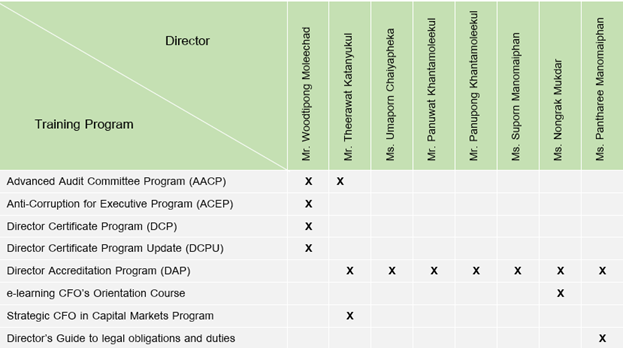
The Company has appropriately applied the knowledge gained from these training courses and seminars in its operations to enhance management efficiency and create long-term value for the Company.
Director Development
In 2025, the Company's directors and executives attended various training courses to continuously enhance their knowledge and develop their potential in performing their duties, with details as follows:
List of Names | Course | Organization |
|
|
|
|
|
|
|
|
|
|
|
|
|
|
|
|
|
|
New Director Orientation
The Board of Directors recognizes the importance of the new director orientation process to enhance directors' readiness in performing their duties. Therefore, the Company Secretary has been assigned to coordinate the orientation process between newly appointed directors and the management, ensuring that directors receive comprehensive and useful information for their duties. The orientation content covers the Company's regulations, corporate governance policy, business ethics, as well as important information regarding the Company's history, business characteristics, shareholding structure, management structure, and business operations, including other matters related to the roles, duties, and responsibilities of directors. Furthermore, the Company arranges site visits to enhance the overall knowledge and understanding of the Company's business and operations for first-time appointed directors.
Qualifications for Director Selection
| Qualification | Skill & Expertise |
|---|---|
| Company directors must be natural persons and of legal age. The selection of individuals to serve as company directors will be conducted through the nomination process by the Nomination and Remuneration Committee, which will consider candidates based on the qualifications stipulated in Section 68 of the Public Limited Company Act B.E. 2535 (1992) and the notifications of the Securities and Exchange Commission (SEC) (Capital Market Supervisory Board Notification No. TorJor. 39/2559 Re: Application for and Approval of Offering Newly Issued Shares) and/or other relevant laws. 1) Possess qualifications and not have prohibited characteristics under the Securities and Exchange Act or criteria prescribed by the SEC Office, and not exhibit characteristics indicating a lack of suitability to be entrusted with the management of a public company as prescribed by the SEC Office. 2) Possess leadership, vision, honesty, integrity, and business ethics. 3) Possess knowledge, ability, and experience beneficial to business operations, demonstrate dedication and business ethics, and have qualifications consistent with the company's strategies and business direction. 4) Be able to exercise independent and straightforward judgment, free from influence by management or any other interested parties. 5) Be able to dedicate sufficient time to the company and diligently perform their duties and responsibilities. 6) Must not engage in any business of the same nature that competes with the company's business, or be a partner in an ordinary partnership, or an unlimited liability partner in a limited partnership, or be a director of a private company or any other company that conducts business of the same nature and competes with the company's business, whether for their own benefit or for the benefit of others, unless the shareholders' meeting has been informed prior to the resolution of appointment. 7) Directors may hold directorships in other businesses, provided that it does not impede their performance as a director of the company. It is stipulated that a director may hold directorships in no more than 5 listed companies on the Stock Exchange of Thailand. | 112 · Description: Economics · 142 · Description: Marketing · 143 · Description: Accounting · 144 · Description: Finance · 1683 · Description: Business Administration |
Evaluation of Board & Subcommittee Performance
Criteria for Evaluating Board Performance
The Board of Directors conducts annual performance evaluations for the Board of Directors and all sub-committees, which include (1) the Audit Committee, (2) the Nomination and Remuneration Committee, (3) the Executive Committee, and (4) the Risk Management Committee. These evaluations are conducted in both collective and individual self-assessment formats, allowing each director to independently assess and provide feedback. The evaluation results are crucial for enhancing the efficiency and effectiveness of the Board of Directors and sub-committees. Details are as follows:
Criteria
The Company prepares self-assessment forms for the entire Board and for individual directors, adapting guidelines from the Stock Exchange of Thailand to suit the nature and structure of the Company's Board of Directors. These forms serve as a tool to help directors review and improve their performance for greater efficiency and effectiveness. The assessment topics align with the key responsibilities of the Board as stipulated by laws, charters, and IOD best practices.
The self-assessment forms for the Board of Directors and sub-committees include the following evaluation topics:
Self-assessment Form for the Board of Directors
|
Collective Board |
Individual Directors (Self-assessment) |
|
7 Categories |
6 Categories |
|
|
|
|
|
|
|
|
|
|
|
|
|
Self-assessment Form for Sub-committees
|
Collective Board |
Individual Directors (Self-assessment) |
|
5 Categories |
6 Categories |
|
|
|
|
|
|
|
|
|
|
|
Scoring is done by each director indicating their opinion by marking (x) in only one score box from 0-4 on the assessment form, with the following meanings:
0 = Strongly Disagree / No action taken on the matter
1 = Disagree / Little action taken on the matter
2 = Agree / Moderate action taken on the matter
3 = Quite Agree / Good action taken on the matter
4 = Strongly Agree / Excellent action taken on the matter
All assessment forms use a percentage-based evaluation criterion from the total score for each item, with the following criteria:
Score greater than 90% = Excellent
Score greater than 80% = Very Good
Score greater than 70% = Good
Score greater than 60% = Fair
Score less than 60% = Needs Improvement
Process for evaluating the Board of Directors and sub-committees
-
The Board of Directors mandates the preparation of performance evaluation forms for the Board of Directors and each sub-committee, both collectively and individually. The Board of Directors approves and reviews these performance evaluation forms annually to ensure accuracy, completeness, and compliance with regulatory criteria.
-
The Company Secretary shall distribute self-assessment forms for all members of the Board of Directors and each sub-committee to all sub-committee members for completion by the end of December each year.
-
Directors and sub-committee members complete the performance evaluation forms and submit the completed forms to the Company Secretary by January 15th of each year.
-
The Company Secretary collects and summarizes the evaluation results and presents them to the Board of Directors for acknowledgment at a Board meeting.
-
The Board will collectively consider and discuss the evaluation results to further enhance the performance of the Board of Directors and sub-committees.
Evaluation of Board Performance in the Past Year
Summary of Performance Evaluation Results for the Board of Directors and Sub-Committees in 2025
|
Evaluation |
Evaluation Results |
Level |
|
Board of Directors (Overall) Board of Directors (Individual) |
94.90 91.70 |
Excellent Excellent |
|
Sub-Committees |
||
|
Audit Committee (Overall) Audit Committee (Individual) |
98.84 97.70 |
Excellent Excellent |
|
Nomination and Remuneration Committee (Overall) Nomination and Remuneration Committee (Individual) |
97.14 94.25 |
Excellent Excellent |
|
Executive Committee (Overall) Executive Committee (Individual) |
92.31 89.04 |
Excellent Very Good |
|
Risk Management Committee (Overall) Risk Management Committee (Individual) |
93.01 89.22 |
Excellent Very Good |
Evaluation Results
| Evaluated Body | Group — Carried Out? | Group — Grade / Average Score | Group — Grade / Full Score | Individual (Self-Assessment) — Carried Out? | Individual (Self-Assessment) — Grade / Average Score | Individual (Self-Assessment) — Grade / Full Score | Cross (Assessing Other Directors) — Carried Out? |
|---|---|---|---|---|---|---|---|
| Board Of Director | Y | 94.90 | 4 | Y | 91.70 | 4 | N |
| Audit Committee | Y | 98.84 | 4 | Y | 97.70 | 4 | N |
| Other Subcommittee | Y | 97.14 | 4 | Y | 94.25 | 4 | N |
| Other Subcommittee | Y | 93.01 | 4 | Y | 89.22 | 4 | N |
| Executive Committee | Y | 92.31 | 4 | Y | 89.04 | 4 | N |
Subcommittees
Subcommittees
| Results of the Subcommittee's Duty Performance |
|---|
In 2025, the Nomination and Remuneration Committee held a total of 2 meetings, with all directors attending every meeting to consider various matters. The Nomination and Remuneration Committee continuously reported the meeting results, along with opinions and recommendations, to the Board of Directors for consideration. The key aspects of its duties are summarized as follows:
|
In 2025, the Risk Management Committee held a total of 2 meetings, with all committee members attending every meeting. The key aspects of their duties can be summarized as follows:
|
Meeting Attendance & Remuneration
Meeting Attendance & Remuneration — Introduction
Board of Directors Meetings
The Board of Directors shall meet as appropriate to its duties, responsibilities, and the nature of the Company's business operations, but not less than 4 times per year. The Board of Directors shall set the meeting dates and regular agendas for meetings in advance for the entire year. The Company Secretary shall inform the directors of the meeting dates for the entire year in advance, starting from the end of the year prior to the meetings in the following year, to allow directors to allocate their time and attend meetings appropriately. Meetings are regularly scheduled for every Thursday, and extraordinary meetings may be held as necessary. The meeting venue shall be in the province where the Company's head office is located, or a nearby province, or any other location, with the date, time, and venue determined at the discretion of the Chairman. In the event that at least 2 directors request a meeting, the Company must convene a Board meeting within 14 days from the date of the request.
When calling a Board of Directors meeting, the Chairman or his/her authorized representative shall send a notice of meeting to the directors at least 7 days before the meeting, unless in urgent and necessary cases to protect the rights and interests of the Company, the meeting may be called by other means and scheduled earlier. The notice of meeting should clearly state the agenda items requiring approval, along with complete and clear supporting documents for consideration.
The Chairman or the Company Secretary shall be assigned to sign the notice of Board of Directors meeting and the minutes of the Board of Directors meeting.
The Chairman shall be assigned to sign the notice of Shareholders' Meeting and the minutes of the Shareholders' Meeting.
For a Board of Directors meeting, at least half of the total number of directors must be present to constitute a quorum. The Chairman shall preside over the Board meeting. In the event that the Chairman is not present at the meeting or unable to perform his/her duties, if there is a Vice Chairman, the Vice Chairman shall preside over the meeting. However, if there is no Vice Chairman or if the Vice Chairman is not present at that meeting or unable to perform his/her duties, the directors present at the meeting shall elect one director to preside over the meeting. The Board of Directors may invite sub-committees, executives, external auditors, and internal auditors of the Company to attend the meeting as necessary and appropriate.
The minimum quorum at the time the Board of Directors votes in a Board meeting must be no less than two-thirds of the total number of directors.
Voting: Resolutions shall be passed by a majority vote. In cases where a majority vote cannot resolve an issue, the Chairman may cast an additional vote to break the tie. However, in matters involving any specific director, the director with a conflict of interest in such matter must abstain from voting on that matter.
For the preparation of meeting minutes, the Company Secretary shall summarize the meeting minutes and submit them for the Chairman's consideration and the Board's acknowledgment.
In 2025, each director shall attend at least 75% of the Board of Directors meetings held during the year, in accordance with the criteria stipulated in the Board of Directors Charter.
Meeting Attendance — Sub-section Introduction
The Board of Directors has a policy to encourage each director to regularly attend Board of Directors meetings, with an average attendance of no less than
75% of all Board of Directors meetings in 2025, with details summarized as follows:
Summary Table of Board Committee Meeting Attendance for 2025
List of Directors | Board of Directors | AC | NRC | RMC | EXCOM | Shareholder Meeting 2025 | |||
Total | In person | Via electronic media | AGM | EGM | |||||
| 8/8 (100%) | 6 | 2 | 5/5 | 1/1 | 1/1 | |||
| 8/8 (100%) | 6 | 2 | 5/5 | 2/2 | 1/1 | 1/1 | ||
| 8/8 (100%) | 6 | 2 | 5/5 | 2/2 | 2/2 | 1/1 | 1/1 | |
| 7/8 87.5% | 6 | 1 | 2/2 | 12/13 | 1/1 | 1/1 | ||
| 8/8 (100%) | 7 | 1 | 13/13 | 1/1 | 1/1 | |||
| 8/8 (100%) | 7 | 1 | 2/2 | 13/13 | 1/1 | 1/1 | ||
| 8/8 (100%) | 6 | 2 | 2/2 | 13/13 | 1/1 | 1/1 | ||
| 8/8 (100%) | 7 | 1 | 2/2 | 13/13 | 1/1 | 1/1 | ||
| 12/13 | ||||||||
| 11/13 | ||||||||
Types of Remuneration of the Board of Directors
The company establishes its director remuneration policy based on principles of appropriateness and fairness, reflecting the roles, duties, responsibilities, and performance of directors, which are linked to the company's operational results. It also considers the business environment and other relevant factors, comparing remuneration rates with those of other companies in the same or similar industries to align with appropriate practices. The Nomination and Remuneration Committee regularly utilizes the results of director remuneration surveys conducted by the Stock Exchange of Thailand and the Thai Institute of Directors (Thai IOD) for comparative consideration each year, ensuring that the remuneration structure is appropriate, consistent with roles and duties, and capable of incentivizing directors to perform their duties effectively.
The Board of Directors, through the Nomination and Remuneration Committee, has considered and deemed that the remuneration for the company's directors is at an appropriate rate, sufficient to attract and retain qualified directors within the company. This was presented to the Board of Directors Meeting No. 1/2568 on February 20, 2568, and the Annual General Meeting of Shareholders 2568 on April 24, 2568, for consideration and approval of the remuneration structure for the Board of Directors and various sub-committees, with the following remuneration rates:
Director Remuneration Payment Monthly payments are made only to the main board of directors who are not executives of the company.
-
Chairman 25,000 Baht/month
-
Director 20,000 Baht/month
Meeting allowance for the Board of Directors Paid per meeting (upon attendance)
-
Chairman 20,000 Baht/meeting
-
Director 15,000 Baht/meeting
Meeting allowance for the Audit Committee Paid per meeting (upon attendance)
-
Chairman 20,000 Baht/meeting
-
Director 15,000 Baht/meeting
Meeting allowance for the Nomination and Remuneration Committee Paid per meeting (upon attendance)
-
Chairman 20,000 Baht/meeting
-
Director 15,000 Baht/meeting
Meeting allowance for the Risk Management Committee Paid per meeting (upon attendance)
-
Chairman (non-executive director) 20,000 Baht/meeting
-
Director (non-executive director) 15,000 Baht/meeting
Other benefits
-
None
Remuneration or Benefits Payable to the Board
| Metric | Amount (Baht) |
|---|---|
| Remunerations or benefits pending payment to the board of directors over the past year (baht) | 0 |
Supervision of Subsidiaries & Associated Companies
Does the Company Have Subsidiaries or Associated Companies?
No
Is There a Mechanism for Overseeing Subsidiaries and Associated Companies?
Yes
Mechanism for Overseeing Management of Subsidiaries
Investment Policy for the Supervision of Subsidiaries, Joint Ventures, and Associated Companies.
The Board of Directors has established an investment policy to oversee subsidiaries, joint ventures, and associated companies as a governance mechanism to control and supervise the operations of subsidiaries, joint ventures, and associated companies, by providing adequate and appropriate measures to monitor the performance of subsidiaries, joint ventures, and associated companies to safeguard the Company's investment interests.
The Company has guidelines for supervising the operations of subsidiaries, joint ventures, and associated companies as follows:
Investment Policy in Subsidiaries, Joint Ventures, and Associated Companies.
The Company has a policy to invest in companies whose operations align with the Company's goals, vision, and growth strategies, which will enhance performance or increase profitability. This includes investments in businesses that generate synergy. To enhance competitive potential and support the Company in achieving its goal of becoming a leading operator in its core businesses.
The Company, its subsidiaries, and/or associated companies may consider investing in other businesses if they have growth potential, can be expanded, or are beneficial to the group's businesses, and can generate good returns on investment. In considering investments by subsidiaries and/or associated companies and/or joint ventures, the Company will conduct a feasibility analysis of the investment and assess its potential and risk factors, with appropriate investment analysis procedures, which must receive approval and/or endorsement from the Board of Directors meeting or the Company's shareholders' meeting (as the case may be). Furthermore, the request for approval for such investments in subsidiaries and/or associated companies and/or joint ventures must comply with the relevant announcements of the Capital Market Supervisory Board and the Stock Exchange of Thailand.
Policy for Supervising Operations in Subsidiaries, Joint Ventures, and Associated Companies.
The Company establishes policies for the supervision and management of subsidiaries, joint ventures, and associated companies with the objective of defining direct and indirect measures and mechanisms to enable the Company to supervise and manage the operations of subsidiaries/joint ventures/associated companies, including monitoring to ensure that subsidiaries, joint ventures, and associated companies comply with the established measures and mechanisms as if they were units of the Company itself, and in accordance with the Company's policies, including public company laws, civil and commercial codes, securities laws, and relevant laws, as well as announcements, regulations, and criteria of the Capital Market Supervisory Board, the Securities and Exchange Commission, and the Stock Exchange of Thailand. This is to safeguard the Company's investment interests in subsidiaries, joint ventures, and associated companies, with details as follows:
2.1 The Company shall establish key policies and management systems, particularly in financial and accounting matters, internal control systems, risk management systems, anti-corruption systems, and other operational systems for subsidiaries, to ensure that the management approach of subsidiaries aligns with and follows the same direction as that of the Company, such as accounting standards, financial policies, and good corporate governance policies.
2.2 The Company has a policy to assign its representatives to serve as directors in subsidiaries, joint ventures, and associated companies, proportionate to the shareholding in each company (Company's representative directors), to oversee that subsidiaries, joint ventures, and associated companies operate in compliance with laws, good corporate governance policies, and other policies of the Company. The Company's Board of Directors shall consider and approve individuals as representative directors in subsidiaries and associated companies, taking into account the suitability of each company.
In the following cases, the Company's representative directors must obtain approval from the Company's Board of Directors meeting before casting votes at the board meetings of such subsidiaries, joint ventures, and associated companies.
Establishment of a legal entity, joint venture, or significant partnership with a legal entity or individual.
Acquisition or disposition of significant shares, businesses, or assets.
Creation of any obligations that will bind or significantly affect the Company, subsidiaries, associated companies, or joint ventures in the long term.
Mergers and acquisitions.
In cases where this policy stipulates that any significant transaction or operation affecting the financial status and operating results of a subsidiary is subject to the Delegation of Authority. The Company's regulations stipulate that approval must be obtained from the Company's Board of Directors meeting and/or the Company's shareholders' meeting (as the case may be). The Company's Board of Directors shall arrange for a Board of Directors meeting and/or a shareholders' meeting (as the case may be) to consider and approve such matters before the subsidiary holds its own Board of Directors meeting and/or shareholders' meeting (as the case may be) to consider and approve the transaction or operation.
In cases where this policy and other policies, procedures, and/or regulations of the Company do not specifically prescribe guidelines for disclosing information related to such transactions, the Company shall disclose information and comply with the principles, conditions, procedures, and methods related to the approved matter as stipulated in the Public Company Limited Act, the Civil and Commercial Code, the Securities and Exchange Act, and relevant laws, as well as relevant announcements, regulations, and criteria of the Capital Market Supervisory Board, the SEC Office, and the Stock Exchange of Thailand, mutatis mutandis (to the extent not contradictory), fully and accurately.
2.3 In the following cases, the subsidiary must obtain approval from the Company's Board of Directors meeting.
Capital increase by issuing new shares of the subsidiary and share allocation, including the reduction of the registered capital and/or paid-up capital of the subsidiary that is not in proportion to the original shareholding of the shareholders, or any other action that would result in the Company's direct and indirect voting rights in the subsidiary's shareholders' meeting, at any level, decreasing by more than 10 percent. of the total votes of that subsidiary.
Amendment of the articles of association and memorandum of association of a subsidiary.
Consideration and approval of the annual budget of subsidiaries and/or approval of significant investments, unless otherwise specified in the subsidiary's Delegation of Authority.
For subsidiaries of significant size, this includes the appointment of the subsidiary's auditor, specifically in cases where such auditor is not affiliated with an auditing firm that is a full member in the same network as the Company's auditor, which would not be in line with the Company's policy for appointing auditors, where the subsidiary's auditor must be affiliated with an auditing firm in the same network as the Company's auditor.
Borrowing, lending, granting credit, providing guarantees, entering into legal acts that obligate the subsidiary to incur additional financial burdens, or providing any other form of significant financial assistance to other persons that is not in the ordinary course of the subsidiary's business.
Dissolution of a subsidiary.
Any other transaction that is not in the ordinary course of the subsidiary's business and has a significant impact on the subsidiary.
Before a subsidiary enters into any transaction or operation with a connected person of the Company or the subsidiary, which falls under the relevant connected transaction notification, or a transaction related to the acquisition or disposition of assets of the subsidiary according to the asset acquisition or disposition notification, where the size of the transaction to be entered into by the subsidiary, when compared to the nature and/or size of the Company (by applying the criteria for calculating the size of the transaction as specified in the notification regarding connected transactions or the notification regarding the acquisition or disposition of assets, as the case may be, mutatis mutandis), results in the Company being required to seek approval from the Company's Board of Directors meeting and/or the Company's shareholders' meeting, or approval from relevant legal authorities before entering into such transaction, the subsidiary may only enter into such transaction or operation after receiving approval from the Company's Board of Directors meeting and/or the Company's shareholders' meeting and/or relevant authorities (as the case may be).
2.4 If a subsidiary enters into a transaction or an event occurs that requires the Company to disclose information to the SEC Office and/or the Stock Exchange of Thailand according to the criteria specified in the relevant announcements of the Capital Market Supervisory Board, the SEC Office, and the Stock Exchange of Thailand, the Company's representative directors who serve as directors and/or executives of such subsidiary are obliged to immediately notify the Company's management upon learning that the subsidiary plans to enter into such transaction.
2.5 The Company's Board of Directors shall monitor and ensure that directors and executives appointed by the Company to serve as directors and executives of subsidiaries, joint ventures, and associated companies (mutatis mutandis) perform their duties and responsibilities in accordance with laws, regulations, and the Company's policies.
2.6 The Company's Board of Directors shall ensure that subsidiaries have financial reporting, internal control systems, risk management systems, anti-corruption systems, and other necessary operational systems, including establishing appropriate, efficient, and stringent measures to monitor the performance of subsidiaries, joint ventures, and associated companies, sufficient to ensure that the operations of subsidiaries, joint ventures, and associated companies are in accordance with the Company's plans, budgets, and policies, as well as laws and announcements regarding good corporate governance for listed companies, including relevant announcements, regulations, and criteria of the Capital Market Supervisory Board, the SEC Office, and the Stock Exchange of Thailand, genuinely and continuously. It shall also monitor that subsidiaries, joint ventures, and associated companies disclose information on financial status and operating results, connected transactions and transactions that may have conflicts of interest, significant asset acquisitions or dispositions, and any other significant transactions to the Company, and that all operations comply fully and accurately with the principles for supervising and managing subsidiaries, joint ventures, and associated companies, as per the relevant announcements of the Capital Market Supervisory Board, the SEC Office, and the Stock Exchange of Thailand (as amended) (as the case may be).
2.7 To stipulate that the directors and executives of subsidiaries, joint ventures, and associated companies have significant scopes of authority, duties, and responsibilities under relevant laws, such as disclosing information regarding financial status and operating results to the Company, by applying relevant announcements of the Capital Market Supervisory Board and the Stock Exchange of Thailand mutatis mutandis, as well as disclosing and submitting information on their own interests and those of related persons to the Company's Board of Directors to inform them of relationships and transactions with the Company, subsidiaries, joint ventures, and associated companies that may give rise to conflicts of interest, and to avoid transactions that may create conflicts of interest.
2.8 The Company shall establish necessary plans and operations to ensure that subsidiaries, joint ventures, and associated companies disclose information regarding their operating results and financial status, and the Company shall take necessary actions and monitor that subsidiaries, joint ventures, and associated companies have adequate and appropriate information disclosure systems and internal control systems for conducting business.
2.9 The Company will closely monitor the performance and operations of subsidiaries, joint ventures, and associated companies, and present analysis results, including opinions or recommendations, to the Company's Board of Directors and the boards of such subsidiaries or associated companies, for consideration in policy formulation or to improve and promote the continuous development and growth of the businesses of subsidiaries, joint ventures, and associated companies.
Oversight Mechanisms
| Mechanism |
|---|
| Sending representatives to act as directors, executives or controlling persons in proportion to shareholdings |
| Defining the scope of powers, duties and responsibilities of directors and executives who represent the company in setting important policies |
| Disclosure of financial information and operating results |
| Transactions between the Company and related persons |
| Other important transactions |
| Acquisition or disposal of assets |
| Internal control system of the subsidiary operating the core business is appropriate and sufficient in the subsidiary operating the core business |
Board Duty Performance — Overview
Board Duty Performance — Overall Description
For the fiscal year 2025, the Board of Directors of Supreme Distribution Public Company Limited has strictly performed its duties as stipulated in the Board Charter to ensure that the company's business operations adhere to good corporate governance principles, are transparent, auditable, and consider the best interests of the company, shareholders, and all stakeholders.
Throughout the past year, the Board of Directors has played a crucial role in setting the organization's strategic direction and policies to align with short-term and long-term goals, as well as closely overseeing management performance, ensuring effective risk management and internal control systems, reviewing compensation policies and structures for directors and executives, and considering and approving significant transactions affecting the company.
Furthermore, the Board emphasizes conducting business under ethical principles, accurate, complete, and transparent information disclosure, as well as regularly reviewing and updating the Board Charter to comply with legal requirements, regulatory guidelines, and international best practices.
Key performance outcomes are as follows:
-
Review and Definition of Organizational Vision, Strategies, and Policies
-
The Board of Directors has reviewed and defined the organization's vision, mission, and strategies to align with the company's short-term and long-term goals, taking into account economic, social, and industry trend factors.
-
Strategic advice has been provided to management to ensure that the company's business operations follow the defined direction and can adapt effectively to changing circumstances.
-
Emphasis is placed on strategic risk management to ensure the company is prepared to address business opportunities and challenges.
-
Oversight and Monitoring of Management Performance
-
The Board of Directors has continuously overseen and monitored the performance of the management to ensure that the company's business operations align with the defined strategic plans and objectives.
-
The annual business plan and budget of the company were considered and approved, with quarterly performance monitoring to ensure that financial results meet targets and strategies can be adjusted to suit economic conditions and industry trends.
-
The performance of the Chief Executive Officer and the senior management team is monitored to ensure that management aligns with the company's policies and strategies.
-
The Board of Directors provides support and guidance to the management in business operations, offering directions for efficient resource management, fostering innovation and organizational development to enhance the company's long-term competitiveness.
-
Good Corporate Governance
-
The Board of Directors has overseen corporate governance in accordance with good governance principles, performing duties with integrity, transparency, and accountability to all stakeholders.
-
Management and governance guidelines have been established to meet international standards, ensuring that the company's business operations are accurate, transparent, and auditable.
-
In 2025, the Board of Directors held 8 meetings to closely monitor the company's performance and ensure that business operations adhered to the established goals and strategies.
-
The performance of the Board of Directors and its sub-committees is evaluated once annually using clear and systematic assessment criteria, with the data utilized to develop and improve governance processes for greater efficiency.
-
Risk Management and Internal Control
-
The Board of Directors has continuously overseen and reviewed risk management policies, including risk management plans, to ensure that the company can manage risks effectively and cope with economic fluctuations and external factors that may impact the business.
-
The Board acknowledged the Audit Committee's report on internal control systems and oversaw the company's efforts to improve internal control systems in line with international standards, thereby enhancing audit efficiency and reducing operational risks.
-
The Board of Directors has monitored the company's risk management performance, emphasizing the identification and assessment of risks at all levels, as well as the establishment of appropriate preventive measures and risk mitigation strategies.
-
Oversight has been provided to ensure the company strictly complies with relevant laws, rules, and regulations, thereby ensuring that the company conducts business in accordance with requirements and maintains transparency in its operations.
-
Governance and Ethical Management
-
The Board of Directors has prioritized governance management and ethical business conduct, overseeing the company's operations in accordance with good corporate governance principles and international standards.
-
Monitoring and oversight are in place to ensure the accurate, complete, and transparent disclosure of the company's financial and general information, enabling shareholders, investors, and stakeholders to access important information equitably and fairly.
-
The Board of Directors has overseen the company's adherence to business ethics, promoting integrity, responsibility, and respect for rules, regulations, and fair practices among employees and management at all levels.
-
Consideration of Compensation and Benefits for Directors and Senior Executives
-
The Board of Directors has overseen and reviewed the compensation and benefits of directors and senior executives fairly and transparently, with a review process that adheres to appropriate and equitable criteria.
-
The compensation for directors and executives has been reviewed to align with the company's performance, taking into account profitability, management efficiency, and success in achieving organizational goals.
-
The Board of Directors has established a competitive compensation structure within the same industry to enable the company to attract and retain highly capable personnel.
-
The Board prioritizes transparency and disclosure regarding compensation, with compensation information for directors reported to shareholders and stakeholders in accordance with established criteria.
-
Consideration and Approval of Significant Company Transactions
-
The Board of Directors has considered and approved significant company transactions, such as related party transactions, in accordance with the regulations of the Stock Exchange of Thailand and the Securities and Exchange Commission (SEC). Measures have been implemented to verify the transparency of related party transactions and to prevent conflicts of interest, ensuring that the company's transactions are fair and consistent with best practices.
-
Approval was granted for the acquisition of fixed assets to support operations and facilitate the company's participation in large-scale project bids, thereby enhancing business potential and accommodating future growth.
-
Review of Board Charter and Various Policies
-
The Board of Directors has continuously reviewed and updated the Board Charter, sub-committees, and various company policies to ensure that the Charter is up-to-date and in compliance with laws, regulations, and good corporate governance principles.
-
The roles, duties, and responsibilities of the Board of Directors have been reviewed and adjusted to align with the company's management structure, and clear governance guidelines have been established to enable the Board to perform its duties effectively.
-
In 2025, the Board of Directors considered and reviewed the Board Charter at the 5th Board of Directors Meeting on August 7, 2025, to ensure that the Charter remains current, appropriate for the company's business context, and in compliance with good governance principles, as well as relevant laws and regulations.
Audit Committee Duty Performance
Results of the Audit Committee's Duty Performance in the Past Year
In 2025, the Audit Committee performed its duties as specified in the Audit Committee Charter, exercising its knowledge and abilities with due care and prudence, and maintaining independence in its duties, having received excellent information and cooperation from the company's management. The Audit Committee supervised and reviewed various aspects as follows:
-
Accuracy, completeness, and reliability of the review of financial reports
The Audit Committee reviewed various important information, including the company's quarterly financial statements, annual financial statements, transactions that may have conflicts of interest, and other significant information, which were prepared in accordance with Thai Financial Reporting Standards (TFRS). The Audit Committee regularly held meetings with the company's auditors and management. During these meetings, significant issues were reviewed, such as the scope of the audit, the accuracy and completeness of financial reports, significant accounting adjustments, accounting estimates, the appropriateness of accounting policies, key audit matters, and the accurate, complete, and sufficient disclosure of information that is beneficial to financial statement users and in compliance with financial reporting standards and relevant laws. Therefore, the Audit Committee approved the financial statements that had been reviewed and audited by the auditors, and the unqualified opinion report.
Additionally, the Audit Committee held one private meeting with the auditors, without management present, to discuss the independence of their duties, the support received from management, the audit of material information in the preparation of financial statements, key audit matters, and the monitoring of the implementation schedule for new financial reporting standards, including related sustainability standards. In 2025, the auditors found no material observations and no suspicious circumstances, ensuring that the company's financial statements are reliable, transparent, and compliant with standards, and that the auditors are independent and auditable.
-
Review of Internal Control
The Audit Committee reviewed the company's internal controls based on internal audit reports, which found no material issues or deficiencies affecting the financial statements. Additionally, the Audit Committee considered the independence of internal audit operations, reviewed the internal audit charter, and reviewed and approved the annual audit plan, as well as provided recommendations and monitored corrective actions on significant issues from the internal auditors, for good corporate governance and to enhance the efficiency and effectiveness of audit operations.
Furthermore, the Audit Committee regularly received summaries of complaints through complaint channels or information regarding various corrupt practices, to monitor for behaviors that might indicate fraud, misconduct, or corruption. The aforementioned actions provide assurance that the company has adequate, appropriate, and effective internal control systems, and no material deficiencies affecting the company's financial statements were found.
-
Review of Risk Management
The Audit Committee acknowledged information on enterprise risk management and reviewed risk management based on the monitoring results of the enterprise risk management plan, to ensure that the company has identified key risk issues that may affect its operations and manages risks effectively, with assigned responsibilities, and that new situations or risks that may arise are monitored to prepare for new risks and to have appropriate, sufficient, and comprehensive risk management measures for all short-term and long-term risk issues.
-
Review of connected transactions or transactions that may have conflicts of interest
The Audit Committee reviewed, supervised, and provided opinions on significant connected transactions, adhering to principles of reasonableness, fairness, transparency, and maximum benefit to the company and its stakeholders. It also oversaw the complete, accurate, and sufficient disclosure of information in accordance with the criteria and regulations of the Stock Exchange of Thailand. During 2025, the Audit Committee reviewed quarterly intercompany transactions to ensure their completeness, accuracy, reasonableness, fairness, and compliance with relevant regulations and rules. The Audit Committee is of the opinion that the intercompany transactions were reasonable and constituted normal business operations of the company.
-
Review of Compliance with the Securities and Exchange Act and the Regulations of the Stock Exchange of Thailand
The Audit Committee reviewed compliance with the Securities and Exchange Act and the regulations of the Stock Exchange of Thailand, as well as regularly assessed the management's compliance with relevant legal requirements. The Audit Committee is of the opinion that no material issues of non-compliance with the Securities and Exchange Act and the regulations of the Stock Exchange of Thailand were found.
-
Consideration of the Appointment of Auditors and Annual Audit Fees
The Audit Committee considered and proposed the appointment of auditors, based on their qualifications, knowledge, abilities, experience in auditing the company's business, audit approach, performance, and independence, in accordance with the professional ethics for accountants prescribed by the Federation of Accounting Professions and the regulations of the Securities and Exchange Commission, including appropriate audit fees. The Audit Committee proposed the appointment of auditors and audit fees for the Board of Directors' consideration and approval, to be presented at the Annual General Meeting of Shareholders. In 2025, shareholders resolved to approve the appointment of KPMG Phoomchai Audit Ltd. (KPMG) as the company's auditor for the year 2025.
-
Other Matters
-
The Audit Committee considered, reviewed, and approved the company's relevant policies before presenting them to the Board of Directors, such as the conflict of interest policy, connected transaction policy, etc., to ensure efficient, transparent, auditable operations, accountability to all stakeholders and related parties, and sustainable value creation for the business. Furthermore, the Audit Committee annually reviewed its charter to align with the principles and best practices prescribed by the Securities and Exchange Commission and regularly reported its performance to the Board of Directors. It also evaluated the performance of the committee as a whole and individually, and reported these findings to the Board of Directors to further enhance the Audit Committee's operational efficiency.
-
Consideration of supporting participation in the Collective Action Against Corruption (CAC) project of the Thai private sector (including consideration and review of the self-assessment form (71-item Checklist) for submission to obtain certification from the CAC project).
-
Consideration of the selection of an Independent Financial Advisor (IFA) to propose to the Board of Directors for an opinion regarding the acquisition or disposal of assets for the Anywere Anytime project.
-
Consideration and approval of the appointment and remuneration of internal auditors for the year 2026 to ensure efficient and independent internal audit operations.
-
Executive Committee Duty Performance
Results of the Executive Committee's Duty Performance in the Past Year
In the year In 2025, the Executive Committee held a total of 13 meetings, with all members of the Executive Committee attending every meeting to screen, supervise, and provide recommendations on various important matters related to organizational management and the company's business operations, as assigned by the Board of Directors and in accordance with the scope of duties and responsibilities defined in the Executive Committee Charter. The key points are as follows:
-
Monitor the company's performance on a monthly basis and provide beneficial recommendations for organizational management and business operations to ensure that the company's operations align with the work plan and budget approved by the Board of Directors efficiently.
-
Monitor, review, and provide opinions on the suitability of various projects according to the company's work plan.
-
Review and approve management restructuring, capital expenditure for investment, and financial transactions with financial institutions to support efficient management and business operations.
-
Define strategies, work plans, and business objectives; prepare business plans, annual budgets, and company investments, including the management structure, approval authority, and administration of the company, for submission to the Board of Directors for consideration and approval.
-
Supervise and advise on the company's business operations to ensure compliance with policies, objectives, and operational plans, as well as monitor the management of various company budgets approved by the Board of Directors for efficiency and effectiveness. This involves regularly monitoring the company's overall operations to drive the company's business towards its defined goals.
-
Consider, approve, and execute various matters related to the company's affairs as stipulated by the company's regulations.