

CG Structure · 2025
In this section21 topics
- Board Composition9 items
- Board of Directors1 item
- Board Meetings & Remuneration6 items
- Balance of Power Between the Board and Management3 items
- Board Roles, Duties and Charter3 items
- Other Board Governance Matters1 item
- Subcommittees — Overview1 item
- Audit Committee6 items
- Executive Committee6 items
- Other Subcommittees1 item
- Executives2 items
- Executive Remuneration3 items
- Remuneration Policy3 items
- Employees3 items
- Employee Remuneration1 item
- Provident Fund5 items
- Policy for Employees Not in the Provident Fund4 items
- Auditors and Audit Fees3 items
- Company Secretary and Other Assigned Persons7 items
- Investor Relations Contact3 items
- Representatives in Thailand (Foreign Companies)1 item
Board Composition
Board Composition — Introduction
The company stipulates that the Board of Directors shall consist of no fewer than 5 directors, with at least half of the total number of directors residing in Thailand, and at least half of the total number being Thai nationals. The Board shall comprise executive directors, non-executive directors, and independent directors, with the proportion of independent directors being no less than one-third of the total number of directors, but not fewer than 3 persons. The proportion of executive directors shall not exceed half of the total number of directors. Furthermore, there shall be at least 1 non-executive director with work experience relevant to the company's business.
The Board of Directors has established a Board Diversity Policy. This policy aims for the Board to comprise individuals with diverse educational qualifications, professional skills, knowledge, expertise, and experience beneficial to the company's business operations and consistent with its business strategies, achieved through the preparation of a Board Skill Matrix. To ensure that the Board of Directors has an appropriate composition and can effectively support corporate governance, without any restrictions or discrimination based on gender, age, race, nationality, religion, or origin, etc. The current structure of the Board of Directors reflects the diversity in qualifications, knowledge, expertise, and experience of its members, which are crucial factors in enhancing the company's potential and suitability for its business operations.
As of December 31, 2025 The Board of Directors consists of 8 members, and its composition can be summarized as follows:
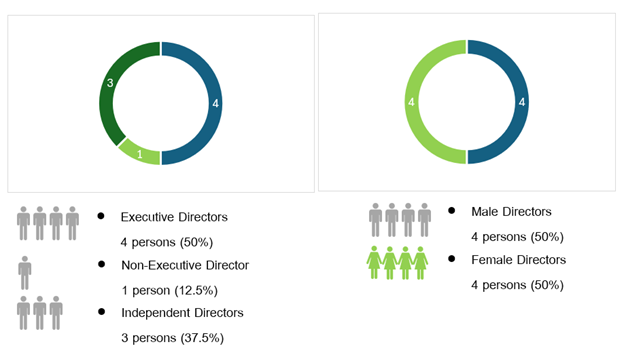
The company does not have any directors or independent directors holding directorships in more than 5 listed companies.
Additionally, the Board of Directors has stipulated that the Chairman of the Board shall be an independent director, in accordance with the definitions set forth by the Capital Market Supervisory Board and the regulations of the Stock Exchange of Thailand. The Chairman of the Board shall have no relationship with management and shall not hold the same position as the Chief Executive Officer, in order to ensure appropriate checks and balances on management's operations, and to clearly separate the roles, duties, and responsibilities of the Chairman of the Board and the Chief Executive Officer.
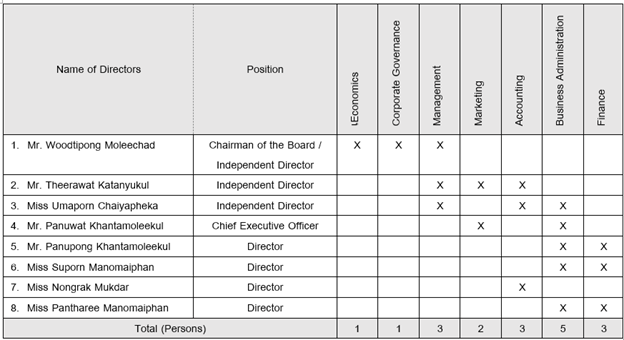
The Board of Directors has assessed the diversity of directors’ skills (Board Skill Matrix) to ensure alignment with and suitability for the Company’s business operations. This assessment covers the essential skills, knowledge, and expertise required, including economics, corporate governance, auditing, marketing, accounting, finance, and business administration. The Board should comprise at least three directors with knowledge and understanding of the Company’s business and at least one director with expertise in accounting and finance, as follows:
Diversity in terms of skills, experience, knowledge, and specialized expertise beneficial to the company.
Total Number of Directors
8
Male Directors
4
Female Directors
4
Independent Directors
3
Non-executive Directors
4
Non-executive Directors Who Are Not Independent
1
Executive Directors
4
Total Board Meetings Held
8
Board of Directors
Directors
| Title | First Name | Last Name | Gender | Year of Birth | Nationality | Resident in Thailand? | Position | Executive or Non-executive | Independent Director? | Director Type | Appointment Date | Authorised to Sign? | Related to Another Director or Executive? | Any Legal Violation in the Past 5 Years? | Highest Education | Field of Study | Field of Study — Please Specify | Skills & Expertise | Director Training | Attended Director Training? | Director Accreditation Program (DAP)? | Director Certification Program (DCP)? | Board Meetings Held | Board Meetings Attended | AGMs Held | AGMs Attended | EGMs Held | EGMs Attended | Meeting Allowance (Baht) | Other Remuneration (Baht) | Total Remuneration (Baht) | Remuneration from Subsidiaries (Baht) | Non-monetary Remuneration | Shares Held | Shareholding (%) | Shares Held by Related Persons (s.59) | Shareholding by Related Persons (s.59, %) |
|---|---|---|---|---|---|---|---|---|---|---|---|---|---|---|---|---|---|---|---|---|---|---|---|---|---|---|---|---|---|---|---|---|---|---|---|---|---|
| Mr. | WOODTIPONG | MOLEECHAD | M | 1,948 | 643 · Description: Thailand | Y | Chairman of the board | Non-executive | Y | Continuing director (Full term of directorship and being re-appointed as a director) | 2023-05-12T00:00 | N | N | N | Bachelor's degree | Economics | 112 · Description: Economics · 166 · Description: Audit · 265 · Description: Governance/ Compliance | 1731 · Year: 2010 · Description: Director Certification Program (DCP) · 1727 · Year: 2022 · Description: Advanced Audit Committee Program (AACP) · 2025 · Description: Anti-Corruption for Executive Program (ACEP) Class 15 · 2025 · Description: Director Certification Program Update (DCPU) Batch 3 · 2025 · Description: Managing ESG for Sustainable Growth: Game-Changing Considerations for Board (Internal Training Course) · 2025 · Description: Corporate Governance in New Normal (Internal Training Course) | Y | N | Y | 8 | 8 | 1 | 1 | 1 | 1 | 160,000 | 300,000 | 460,000 | 0 | 0 | 0 | 0 | 0 | 0 | |
| Mr. | THEERAWAT | KATANYUKUL | M | 1,967 | 643 · Description: Thailand | Y | Director | Non-executive | Y | Existing director | 2023-05-12T00:00 | N | N | N | Master's degree | other | MBA (Finance) | 142 · Description: Marketing · 143 · Description: Accounting · 166 · Description: Audit | 1730 · Year: 2022 · Description: Director Accreditation Program (DAP) · 1727 · Year: 2024 · Description: Advanced Audit Committee Program (AACP) · 2018 · Description: Strategic CFO in Capital Markets Program, Batch 6, organized by The Stock Exchange of Thailand · 2025 · Description: Insight in SET: ID & AC Focus: Comprehensive Knowledge for Growth and Sustainability in the Capital Market, Organized by the Stock Exchange of Thailand · 2025 · Description: The Evolving Role of Audit Committee in Fostering Trust and Transparency, 4th Edition, organized by the Thai Institute of Directors Association (IOD) | Y | Y | N | 8 | 8 | 1 | 1 | 1 | 1 | 120,000 | 240,000 | 360,000 | 0 | 0 | 408,300 | 0.06 | 0 | 0 |
| Ms. | UMAPORN | CHAIYAPHEKA | F | 1,968 | 643 · Description: Thailand | Y | Director | Non-executive | Y | Existing director | 2023-05-12T00:00 | N | N | N | Master's degree | Business Administration | 1683 · Description: Business Administration · 143 · Description: Accounting · 166 · Description: Audit | 1730 · Year: 2023 · Description: Director Accreditation Program (DAP) · 1740 · Year: 2025 · Description: The Board’s Role in Mergers and Acquisitions (BMA) · 2025 · Description: Insight in SET: ID & AC Focus, Comprehensive Understanding for Growth and Sustainability in the Capital Market, Organized by The Stock Exchange of Thailand · 2025 · Description: New format for the presentation and disclosure of information in financial statements according to IFRS 18, organized by The Federation of Accounting Professions. · 2024 · Description: Introduction to IFRS S1 and IFRS S2 organized by the Federation of Accounting Professions. · 2022 · Description: ASEAN Accountancy Conference on Sustainability organized by the Federation of Accounting Professions · 2025 · Description: The Evolving Role of Audit Committee in Fostering Trust and Transparency | Y | Y | N | 8 | 8 | 1 | 1 | 1 | 1 | 120,000 | 240,000 | 360,000 | 0 | 0 | 0 | 0 | 0 | 0 | |
| Mr. | PANUWAT | KHANTAMOLEEKUL | M | 1,967 | 643 · Description: Thailand | Y | Director | Executive | Existing director | 2023-05-12T00:00 | Y | Y | N | Bachelor's degree | other | Marketing | 142 · Description: Marketing | 1730 · Year: 2022 · Description: Director Accreditation Program (DAP) | Y | Y | N | 8 | 7 | 1 | 1 | 1 | 1 | 0 | 0 | 0 | 0 | 0 | 230,000,000 | 31.08 | 20,000,000 | 2.7 | |
| Mr. | PANUPONG | KHANTAMOLEEKUL | M | 1,995 | 643 · Description: Thailand | Y | Director | Executive | Existing director | 2023-05-12T00:00 | Y | Y | N | Master's degree | other | Master of Science in Business, Finance | 1683 · Description: Business Administration · 144 · Description: Finance | 1730 · Year: 2022 · Description: Director Accreditation Program (DAP) · 3186 · Year: 2024 · Description: ESG in the Boardroom: A Practical Guide for Board (ESG) · 1740 · Year: 2024 · Description: The Board’s Role in Mergers and Acquisitions (BMA) · 1733 · Year: 2025 · Description: Ethical Leadership Program (ELP) | Y | Y | N | 8 | 8 | 1 | 1 | 1 | 1 | 0 | 0 | 0 | 0 | 0 | 20,000,000 | 2.7 | 0 | 0 | |
| Ms. | NONGRAK | MUKDAR | F | 1,976 | 643 · Description: Thailand | Y | Director | Executive | Existing director | 2023-05-12T00:00 | Y | N | N | Bachelor's degree | Accounting | 143 · Description: Accounting | 1730 · Year: 2023 · Description: Director Accreditation Program (DAP) · 2022 · Description: CFO’s Orientation e-learning hosted by The Stock Exchange of Thailand · 2023 · Description: CPD Accounting Course 2023 (TAS 19 and TFRS), totaling 12 hours, organized by the Federation of Accounting Professions. · 2025 · Description: Case Study for Pack5&Fair Value organized by the Federation of Accounting Professions | Y | Y | N | 8 | 8 | 1 | 1 | 1 | 1 | 0 | 0 | 0 | 0 | 0 | 400,000 | 0.05 | 0 | 0 | ||
| Ms. | SUPORN | MANOMAIPHAN | F | 1,967 | 643 · Description: Thailand | Y | Director | Non-executive | N | Existing director | 2023-05-12T00:00 | Y | Y | N | Bachelor's degree | other | Financial Management and Banking | 1683 · Description: Business Administration · 144 · Description: Finance | 1730 · Year: 2022 · Description: Director Accreditation Program (DAP) | Y | Y | N | 8 | 8 | 1 | 1 | 1 | 1 | 0 | 0 | 0 | 0 | 0 | 20,000,000 | 2.7 | 230,000,000 | 31.08 |
| Ms. | PANTHAREE | MANOMAIPHAN | F | 1,970 | 643 · Description: Thailand | Y | Director | Executive | Continuing director (Full term of directorship and being re-appointed as a director) | 2023-05-12T00:00 | Y | Y | N | Master's degree | other | Finance and Banking | 1683 · Description: Business Administration · 144 · Description: Finance | 1730 · Year: 2023 · Description: Director Accreditation Program (DAP) · 3185 · Year: 2024 · Description: Director’s Guide to Legal Obligations and Duties (DLD) · 2025 · Description: Course on Risk Assessment in Bribery of Public Officials, Organized by the National Anti-Corruption Commission (NACC). · 2025 · Description: Measures concerning high-risk bribery cases and the application of anti-bribery measures to business associates of the legal entity, organized by the National Anti-Corruption Commission. | Y | Y | N | 8 | 8 | 1 | 1 | 1 | 1 | 0 | 0 | 0 | 0 | 0 | 1,000,000 | 0.14 | 0 | 0 |
Board Meetings & Remuneration
Date of the Annual General Meeting
2025-04-24T00:00
Was an Extraordinary General Meeting Held?
Yes
Dates of Extraordinary General Meetings
| Meeting Date |
|---|
| 2025-10-22T00:00 |
Board Meeting Allowance (Baht)
400000.0
Other Board Remuneration (Baht)
780000.0
Total Board Remuneration (Baht)
1180000.0
Balance of Power Between the Board and Management
Are There Measures Balancing the Board's and Management's Power?
Yes
Measures Balancing the Board's and Management's Power
Measures and methods for balancing power between the Board of Directors and management.
-
The company stipulates that the positions of Chairman of the Board and Chief Executive Officer shall not be held by the same person, to ensure an appropriate balance of power in management.
-
The Chairman of the Board is Mr. Wuttipong Moleechart, who is an independent director and not the same person as the Chief Executive Officer, nor do they have any blood or business relationship. Furthermore, the roles, duties, and responsibilities of the Chairman of the Board and the Chief Executive Officer are clearly separated to create a balance in the exercise of executive power, support the Board's performance of duties and corporate governance, and enhance transparency in the organization's operations in accordance with good corporate governance principles.
In this regard, the company has established the Board of Directors Charter and charters for various sub-committees, which define the scope of duties, responsibilities, and authorities of each committee, as well as clearly separating the roles and responsibilities of the Chairman of the Board and the Chief Executive Officer, in accordance with good corporate governance principles.
Roles and Responsibilities of the Chairman of the Board
-
Oversee the overall strategy and trends of the company to ensure legal compliance, both in terms of government agency regulations and company policies, as well as resolutions of shareholders' meetings.
-
Establish a system for monitoring and overseeing the company's operations to ensure continuous compliance with policies.
-
Supervise, monitor, and ensure that the performance of the Board's duties is efficient and achieves the organization's objectives and goals.
-
Ensure that all directors participate in promoting an ethical organizational culture and good corporate governance.
-
Support coordination and collaboration among the Board of Directors, management, and the company secretary to ensure all parties can work together smoothly and efficiently.
-
Promote compliance with the company's corporate governance, social, and environmental responsibility policies, and foster ethical conduct among personnel at all levels.
-
Support and encourage all directors to participate in training and development programs to enhance their skills and knowledge in various areas beneficial to their duties as directors, at reputable and recognized institutions such as the Thai Institute of Directors (IOD) and the Stock Exchange of Thailand, among others.
-
The Chairman of the Board is responsible for calling Board meetings. For such meetings, the Chairman or an assigned person shall send a notice of meeting to directors at least 7 days before the meeting date, except in urgent cases. Directors, numbering two or more, may request a Board meeting. In such cases, the Chairman shall set the date and call the meeting within 14 days. If the Chairman is unable to perform their duties, two or more directors shall jointly call the meeting.
-
Serve as the chairman of meetings and attend all meetings to ensure efficient conduct of Board meetings, including encouraging all directors to express their opinions. Organizational management authority is appropriately delegated to management. Ensure that all directors receive accurate, timely, and clear company information for decision-making, which will lead to the company's efficient success.
-
Consider and determine the agenda for Board of Directors' meetings in conjunction with the Chief Executive Officer, with measures to ensure that important matters and those within the scope of authority are included in the agenda.
-
Allocate sufficient time for management to present matters and for directors to thoroughly discuss important issues collectively, as well as encourage directors to exercise prudent judgment and provide independent opinions.
-
Serve as the chairman of all shareholders' meetings and assign a person to oversee the shareholders' meetings to ensure compliance with laws and regulations. Also, ensure that all directors attend the shareholders' meetings together, providing shareholders with full opportunity to exercise their rights at the meetings, including attending and voting, asking questions, or requesting further clarification.
Roles and Responsibilities of the Chief Executive Officer
The Chief Executive Officer plays a crucial role in setting the direction and managing the company's operations in accordance with the policies and resolutions of the Board of Directors, with the following key responsibilities:
-
Operate and manage the company's business in accordance with various laws, including the Securities and Exchange Act, announcements of the Securities and Exchange Commission, announcements of the Capital Market Supervisory Board, announcements of the Stock Exchange of Thailand, objectives, regulations, policies, rules, requirements, orders, and resolutions of the Board of Directors' meetings and/or resolutions of the shareholders' meetings.
-
Oversee, manage, operate, and perform daily business activities for the benefit of the company, in accordance with the policies, vision, goals, business plan, and budget determined by the Board of Directors' meeting.
-
Manage the company's operations in accordance with its core mission (as defined by the Board of Directors to align with the company's business plan, budget, and relevant business strategies as determined by the Board of Directors).
-
Oversee financial, marketing, human resources, and other operational activities collectively to ensure compliance with the company's policies and operational plans established by the Board of Directors.
-
Possess the authority to hire, appoint, transfer, dismiss, terminate employment, and determine wage rates and compensation for company employees, and may appoint sub-delegates to act on their behalf.
-
Determine rewards, salary increases, compensation, and special bonuses, in addition to regular bonuses, for company employees from the level of department director downwards.
-
Negotiate and enter into contracts and/or any transactions related to the company's normal business operations, with the financial limits for each item being in accordance with the approval and operational authority granted by the Board of Directors.
-
Issue orders, regulations, announcements, and various internal memos within the company to ensure its operations comply with policies and serve the company's interests, as well as to maintain internal discipline.
-
Possess the authority to determine commercial terms for the benefit of the company, in accordance with the approval and operational authority granted by the Board of Directors.
-
Consider investment in new businesses or divestment from existing businesses, for submission to the Board of Directors.
-
Approve and appoint various consultants necessary for operations, in accordance with the approval and operational authority granted by the Board of Directors.
-
Grant authority to sub-delegate and/or assign specific tasks to other individuals. Such sub-delegation and/or assignment shall be within the scope of authority as stipulated in the power of attorney and/or in accordance with the regulations, requirements, or orders established by the company's Board of Directors. However, the delegation of duties and responsibilities by the Chief Executive Officer must not constitute a delegation or sub-delegation that allows the Chief Executive Officer or their delegate to approve transactions in which they or a person who may have a conflict of interest (as defined in the announcements of the Securities and Exchange Commission or the Capital Market Supervisory Board) may have an interest, or may receive benefits of any kind, or may have any other conflict of interest with the company, except for the approval of transactions that are in accordance with policies or transactions that the shareholders' meeting or the Board of Directors has considered and approved for themselves or persons who may have a conflict of interest.
-
Perform other duties assigned by the Board of Directors, and possess the authority to undertake any necessary actions for the performance of such duties.
Methods Used to Balance Power
| Method | Other — Please Specify |
|---|---|
| Other | The positions of Chairman of the Board and Chief Executive Officer must not be held by the same person. |
Board Roles, Duties and Charter
Board Roles and Duties — Introduction
The Board of Directors acts as a representative of the shareholders and plays a crucial role in setting the company's direction, policies, vision, mission, and business strategies, as well as overseeing the company's operations to align with established objectives and goals, in order to maximize benefits and increase economic value for shareholders and the company as a whole.
Furthermore, the Board of Directors is responsible for overseeing and monitoring the management's operations to ensure efficiency, transparency, and adherence to good corporate governance principles. The duties and responsibilities of the Board of Directors are as stipulated in the Board of Directors Charter, which is reviewed annually and was approved by the Board of Directors Meeting No. 5/2025 on August 7, 2025, effective from August 11, 2025, onwards.
Roles, Duties, and Responsibilities of the Board of Directors.
Operational aspects.
Define the company's vision, mission, goals, strategies, and policies.
As the Board of Directors does not perform executive management duties, it delegates to the Executive Committee and management the responsibility of preparing short-term and long-term plans for submission to the Board. The Board will monitor and ensure that the established plans are implemented efficiently. Therefore, the Executive Committee must provide a short-term plan showing clear and measurable objectives, and a long-term plan showing the overall business vision and concepts and the company's future. Furthermore, management should regularly evaluate performance and present any deviations to the Board. Management should also provide other useful information for planning and policy formulation to the Board, to analyze problems, causes, and make decisions to adjust strategies or business plans appropriately, taking into account ethics, social, and environmental impacts as important considerations.
Policy formulation.
2.1 Establish policies and guidelines for management to implement both short-term and long-term strategic plans, create clarity regarding the direction of business operations, and serve as a communication tool between the Board and management. Policies should be flexible and adaptable to business situations, covering business functions. Once the Board has set policies for the company, there should be a system for explaining or disseminating information to personnel at all levels of the organization.
To foster mutual understanding and ensure operations align with established policies. Policies must be reviewed and updated periodically to keep pace with changing circumstances.
2.2 Establish policies and oversee the company's effective anti-corruption system to ensure that management is aware of and prioritizes anti-corruption efforts, fostering it as part of the organizational culture. The Board of Directors must also comply with anti-corruption measures and impose penalties for non-compliance.
2.3 Consider, approve, and review anti-corruption policies and practices, promoting and supporting the communication of these policies and practices to ensure that all relevant personnel and stakeholders are aware of their importance and can implement them effectively.
Selection, removal, and approval of the Chief Executive Officer's remuneration.
In considering the selection of the Chief Executive Officer, the Board of Directors appoints a Nomination and Remuneration Committee to select the Chief Executive Officer, clearly define the scope of duties and powers of the Chief Executive Officer, and evaluate the Chief Executive Officer's performance, which should be based on clear and tangible criteria and indicators. The Board... The Chief Executive Officer should be informed of expectations, and results should be communicated clearly and straightforwardly. The delegation of authority within the defined scope of duties must not be such that it allows the Chief Executive Officer to consider and approve transactions in which they may have a conflict of interest or any other conflict of interest with the company or its subsidiaries (if any), except for transactions approved in accordance with policies and criteria already considered and approved by the Board of Directors.
Regarding the removal of the Chief Executive Officer, the Board establishes criteria and procedures for such removal to protect the interests of the company and its shareholders, and also implements a process for preparing personnel to replace those in key positions who may resign or retire (Succession Plan). Another important duty of the Board is to establish criteria and policies for determining the remuneration of company directors, the Chief Executive Officer, and senior executives of various departments as assigned by the Board of Directors. The annual remuneration for the Chief Executive Officer and senior executives of various departments will be submitted to the Board of Directors for consideration and approval. For directors, the Board of Directors will propose their remuneration to the shareholders' meeting for consideration and approval.
Appointment of Sub-Committees.
The Board of Directors may consider appointing sub-committees as appropriate, based on the size and business nature of the organization, to alleviate the Board's burden in areas requiring review or detailed study. When appointing sub-committees, the Board should clearly define their objectives, duties, responsibilities, and powers. To ensure efficient and effective operation of sub-committees, the Board should require management to provide support in terms of both information and personnel to the sub-committees, and allow them to contact or seek advice from external personnel as deemed appropriate, with the company bearing the expenses.
The delegation of authority within the defined scope of duties must not be such that it allows the aforementioned sub-committees to consider and approve transactions in which they may have a conflict of interest or any other conflict of interest with the company or its subsidiaries (if any), except for transactions approved in accordance with policies and criteria already considered and approved by the Board of Directors.
The Board requires regular reports on the performance of all sub-committees to be submitted to the Board to consistently monitor delegated operations.
Appointment of Company Secretary.
The Board of Directors shall consider appointing a company secretary with the necessary and appropriate knowledge and experience to be responsible for various operations on behalf of the company and to assist the Board of Directors in its duties to ensure that the company's business operations comply with relevant laws, announcements, and regulations, such as preparing and maintaining the register of directors, notices of Board meetings, and minutes of Board meetings, notices of shareholders' meetings and minutes of shareholders' meetings, and maintaining records of interests, etc. The Board shall also define the scope of authority, duties, and responsibilities, and may remove the company secretary from office as deemed appropriate.
Oversight.
Management's operations.
The Board of Directors has delegated daily management duties to the executive management. However, the Board remains responsible for overseeing and monitoring the company's general operations to ensure compliance with relevant laws, rules, and regulations, as well as adherence to established goals and plans. To effectively monitor, the Board should be continuously aware of the company's operational status, including internal and external factors that may affect the organization, and should seek knowledge about business trends to adapt policies or strategies to changing environments.
Risk management.
The Board of Directors should ensure that management is aware of potential risks and establish appropriate and clear risk management systems and tools. The Board should approve the company's risk management action plan prepared by management, and require management to implement, analyze, and regularly evaluate the suitability of the action plan. The Board may delegate these duties to management or the Risk Management Committee.
Compliance with rules, regulations, and policies.
The Board of Directors should establish effective internal control and internal audit systems to ensure that the company complies with laws, regulations, and official requirements, as well as the company's policies and procedures. Such systems will serve as tools to promptly identify deficient practices. Furthermore, the Board considers important audit reports from the Audit Committee or internal audit unit, as well as auditors and various company advisors, and is responsible for setting guidelines for corrective actions. In cases where significant deficiencies are found, a system for regularly monitoring and evaluating the adequacy of operational standards and internal control systems should be established.
Information disclosure and communication with stakeholders.
For transparency in the company's operations, the Board of Directors should ensure regular communication between the company, shareholders, and other stakeholders, with management disclosing important information accurately and promptly. Therefore, the Board must establish a system to ensure that all disclosed information is accurate, complete, and timely.
Other aspects.
In cases where the Board of Directors appoints one or more directors or other persons to act on behalf of the Board, the delegated authority must not include the power to approve transactions in which such person or a person who may have a conflict ("person who may have a conflict" shall have the meaning as defined in the announcement of the Securities and Exchange Commission) has an interest or may have any other conflict of interest with the company or its subsidiaries.
Except for the following matters, which may only be undertaken after obtaining prior approval from the shareholders' meeting. It is stipulated that for transactions in which a director or a person who may have a conflict, an interest, or any other conflict of interest with the company or its subsidiaries, the director with such an interest shall not be entitled to vote on that matter.
(1) Matters required by law to be resolved by a shareholders' meeting.
(2) Transactions in which a director has an interest and which are required by law or stock exchange regulations to be approved by a shareholders' meeting.
(3) Furthermore, in the following cases, approval must be obtained from both the Board of Directors meeting and the shareholders' meeting with a vote of not less than three-fourths of the total votes of shareholders attending and entitled to vote.
The sale or transfer of all or a significant part of the company's business to another person.
Entering into, amending, or terminating contracts related to the lease of all or a significant part of the company's business.
Delegation to another person to manage the company's business or merger with another person with the objective of sharing profits and losses.
Issuance of new shares to creditors of the company under a debt-to-equity conversion scheme.
Reduction of the company's registered capital by reducing the number of shares or reducing the par value of shares.
Capital increase, capital decrease, issuance of debentures, merger or dissolution of the company.
Any other matters as prescribed by law.
In any matter where a director has an interest or a conflict of interest with the company or its subsidiaries, the director with such an interest or conflict of interest shall not be entitled to vote on that matter.
Furthermore, the Board of Directors has the scope of duties to oversee the company's compliance with securities and stock exchange laws, stock exchange regulations, such as related party transactions, acquisition or disposition of assets, according to the rules of the Stock Exchange of Thailand, or announcements of the Securities and Exchange Commission, the Capital Market Supervisory Board, or laws related to the company's business.
The Board of Directors is responsible for reviewing items to be submitted for shareholder approval at the shareholders' meeting. The main agendas for the Annual General Meeting of Shareholders are as follows:
Consider the Board's report presented to the meeting, showing the company's operational results.
Consider and approve financial statements.
Consider the allocation of company profits.
Propose a list of new directors to replace those retiring by rotation.
Propose the appointment of auditors and determine their remuneration.
Consider items that may create conflicts of interest, specifically those requiring shareholder approval.
Other matters.
5. The Board of Directors must promptly inform the company in the following cases:
Having a direct or indirect interest in any contract entered into by the company.
Holding shares or debentures in the company or its affiliates, specifying the total increase or decrease.
6. Prepare annual reports and be responsible for ensuring that financial reports are accurate, complete, and in accordance with financial reporting standards, and are audited by an auditor before being presented to the shareholders' meeting for further consideration and approval.
Powers and Responsibilities of the Board of Directors.
Signing authority.
As the company is a legal entity, it cannot sign legal acts on its own. The company will appoint one or more directors as authorized signatories, along with the company's seal, to enter into legal acts binding the company with external parties, by registering the conditions for signing to bind the company in the certificate of incorporation.
Responsibilities of the Board of Directors.
In performing their duties, directors must act in accordance with the law, the company's objectives and articles of association, and resolutions of shareholders' meetings, with honesty, integrity, and due care, prioritizing the company's interests. The following principles shall be adhered to:
2.1 Principles of Due Care.
Directors have a legal duty to perform their duties with the level of care expected of a reasonable person. Once such care has been exercised, directors shall not be personally liable for damages incurred by the company.
2.2 Principles of Honesty and Integrity.
Directors must perform their duties with honesty and integrity, and safeguard the company's interests. They must prioritize the company's collective interests over their personal interests, protect the interests of all shareholders without limitation to any specific shareholder or group, and refrain from engaging in any transactions or activities that may create a conflict of interest between themselves and the company. This includes not using their position or inside information obtained as a director to seek benefits for themselves or any other person. If a director has a direct or indirect interest in any contract entered into by the company, they must promptly inform the company.
2.3 Principles of Understanding the Organization's Business.
Directors must possess knowledge and understanding of the company's business to effectively oversee its management and to be considered to have exercised due care.
2.4 Principles of Duty to Attend Board Meetings.
The management of the Board's affairs shall be conducted through Board meetings. Therefore, it is an important duty for directors to attend Board meetings, and attending directors shall bear joint responsibility, unless explicitly stated otherwise.
Furthermore, in accordance with good corporate governance principles and practices, directors should attend no less than 75% of all Board of Directors meetings held during the year.
Term of Office of the Board of Directors.
Directors serve for a term of 3 years, and upon completion of their term, may be considered for re-election as directors.
The Board of Directors shall elect and appoint one director as Chairman. If the Board deems appropriate, it may elect one or more directors as Vice-Chairmen. Vice-Chairmen shall perform duties as stipulated in the articles of association for matters assigned by the Chairman.
The Board of Directors shall elect and appoint one director as Chief Executive Officer by a majority vote.
At every Annual General Meeting, one-third of the directors currently in office shall retire. The director who has been in office for the longest period shall be the one to retire. A retiring director may be re-elected.
A shareholders' meeting may resolve to remove any director from office before the expiration of their term by a vote of not less than three-fourths of the shareholders attending and entitled to vote, and holding shares totaling not less than one-half of the shares held by shareholders attending and entitled to vote.
Independent directors may serve for a continuous period not exceeding nine (9) years from the date of their initial appointment as an independent director, unless the Board of Directors resolves that such independent director has significantly contributed to the company and is suitable to serve for a longer period, and that serving beyond nine (9) years does not compromise their independence. However, if the Board of Directors approves an independent director to serve continuously for more than nine (9) years, the Board will present the reasons for requesting the shareholders' meeting to consider and approve the appointment of such director as an independent director for a further term.
In the event that a director's position becomes vacant for reasons other than the expiration of their term, the Board of Directors shall select a person who possesses the qualifications and is not disqualified under the Public Limited Company Act and the Securities and Exchange Act to fill the vacancy at the next Board meeting, unless the remaining term of that director is less than 2 months. The person appointed to fill the vacancy shall serve only for the unexpired term of the director they replace. The aforementioned resolution of the Board of Directors must be passed by a vote of not less than three-fourths of the remaining directors.
Directorship in Other Listed Companies
In accordance with the Board of Directors’ Charter, directors may hold directorships in other companies, provided that such positions do not hinder the performance of their duties to the Company. Directors are permitted to serve as directors in listed companies on the Stock Exchange of Thailand (“SET”) for no more than five companies. In 2025, none of the Company’s directors held directorships in more than five listed companies.
The Chief Executive Officer may serve as a director in other companies, provided that such roles do not interfere with the performance of duties to the Company and that such companies do not engage in the same business or compete with the Company. In this regard, prior approval from the Board of Directors is required before accepting such positions, with prior consideration and recommendation from the Nomination and Remuneration Committee. The Company shall also disclose such information in the Annual Registration Statement/Annual Report in accordance with the relevant regulations.
Approval Authority of the Board of Directors.
The Board of Directors has the authority to approve various company matters within the scope of powers defined by law, the company's articles of association, the Board of Directors Charter, resolutions of shareholders' meetings, regulations, and relevant delegation of authority principles. This includes setting strategic plans and business objectives, approving annual revenue and expenditure budgets, including investment budgets, monitoring and evaluating operational performance according to established plans, as well as overseeing significant investment expenditures and related party transactions. Furthermore, the Board of Directors also has the authority to consider and approve mergers, demergers, and joint ventures, the appointment of individuals to serve as directors and executives in other companies, including determining their remuneration, organizational structure and chart adjustments, succession planning, appointment, transfer, and termination of senior executives, performance evaluations, as well as determining the remuneration and salary adjustment and bonus policies for the Chief Executive Officer.
The Board of Directors also has the authority to consider and approve financial statements, changes in accounting policies or accounting standards, and legal actions related to the company, in order to ensure efficient, transparent management that aligns with good corporate governance principles.
Does the Company Have a Board Charter?
Yes
Content of the Board Charter
The Board of Directors, as the leader and highest responsible body of the organization, plays a crucial role in overseeing the company's business operations to ensure the company achieves good performance and sustainable long-term growth, building confidence for shareholders and all stakeholders, as well as aiming to create maximum value and benefits for the company.
The Board of Directors performs its duties independently from management, adhering to the principles of accountability, due care, and integrity in performing its duties, as well as ensuring compliance with laws, objectives, the company's articles of association, resolutions of the Board of Directors, and resolutions of shareholders' meetings.
In this regard, the company has established a Board of Directors Charter to clearly define the scope of authority and responsibilities of the Board of Directors, including the roles and duties of the Chairman, and mandates an annual review of the said Charter to align with the organization's goals, strategies, and business direction.
Other Board Governance Matters
Board Governance Practices
| Practice | Yes / No |
|---|---|
| The chairman of the board and the highest-ranking executive are from the same person | N |
| The chairman of the board is an independent director | Y |
| The chairman of the board and the highest-ranking executive are from the same family | N |
| Chairman is a member of the executive board or taskforce | N |
| The company appoints at least one independent director to determine the agenda of the board of directors’ meeting | N |
Subcommittees — Overview
Subcommittees — Introduction
As of December 31, 2025, the Company has 4 sub-committees, namely:
Audit Committee
Risk Management Committee
Nomination and Remuneration Committee
Executive Committee
Each sub-committee has a charter approved by the Board of Directors. The charter clearly defines its objectives, composition, qualifications, appointment criteria and term of office, meetings, as well as powers, duties, and responsibilities. The sub-committees shall review and revise their charters at least once a year or when there are significant changes, and present them to the Board of Directors for approval.
Furthermore, each sub-committee shall report significant operational results to the Board of Directors quarterly for their acknowledgment, to ensure effective corporate governance and adherence to good corporate governance principles.
Audit Committee
Audit Committee — Introduction
As of December 31, 2025, the Audit Committee comprises a total of 3 independent directors, whose names are as follows:
Audit Committee Charter
| Roles, Duties and Responsibilities | Type of Subcommittee |
|---|---|
Audit Committee Composition
1. Audit Committee members must be company directors.
2. The Audit Committee must consist of at least
3 independent directors. 3. Audit Committee members must be appointed by the Board of Directors or the Shareholders' Meeting.
4. At least one Audit Committee member must possess knowledge, understanding, or experience in accounting or finance sufficient to review the reliability of financial statements.
5. The Audit Committee shall consider appointing a suitable person to serve as the Secretary of the Audit Committee.
Term of Office and Removal from Office
1) The term of office for an Audit Committee member is 3 years. An Audit Committee member whose term has expired may be re-appointed. However, an Audit Committee member may serve for a continuous period not exceeding nine (9) years from the date of their initial appointment, unless the Board of Directors resolves that the said Audit Committee member has significantly contributed to the Company and is suitable to serve for a longer period, and that serving beyond nine (9) years does not impair their independence. Nevertheless, if the Board of Directors approves the continuous appointment of an Audit Committee member for more than nine (9) years, the Board of Directors shall present the reasons for seeking approval from the Shareholders' Meeting for the re-appointment of such director as an Audit Committee member.
2) Completion of the term as a company director. An Audit Committee member whose term has expired may be re-appointed. In the event of re-appointment as a company director, that director shall continue to serve as an Audit Committee member for the remainder of their original term.
3) Disqualification as an Audit Committee member according to the Audit Committee Charter, the Securities and Exchange Act, or the regulations of the Stock Exchange of Thailand and the Securities and Exchange Commission.
4) Resignation from the Audit Committee, requiring at least 30 days' prior written notice to the Chairman of the Board of Directors, along with the reasons.
5) Death. If an Audit Committee member vacates office before the expiration of their term, the newly appointed Audit Committee member shall serve for the remaining period of the vacating member's term.
Qualifications of Audit Committee Members
1) Holds shares not exceeding 1% of the total voting shares of the Company, its parent company, subsidiaries, associated companies, major shareholders, or controlling persons of the Company. This includes shares held by related persons of that independent director.
2) Is not or has not been an executive director, employee, staff, regular salaried advisor, or controlling person of the Company, its parent company, subsidiaries, associated companies, fellow subsidiaries, major shareholders, or controlling persons of the Company, unless such status has ceased for at least 2 years prior to appointment. This prohibition does not include cases where the independent director was a government official or an advisor to a government agency that is a major shareholder or controlling person of the Company.
3) Is not a person related by blood or legal registration as a parent, spouse, sibling, or child, including the spouse of a child, of an executive, major shareholder, controlling person, or a person to be nominated as an executive or controlling person of the Company or its subsidiary.
4) Has no or has not had a business relationship with the Company, its parent company, subsidiaries, associated companies, major shareholders, or controlling persons of the Company in a manner that may interfere with their independent judgment. This also includes not being or having been a significant shareholder or controlling person of a party having a business relationship with the Company, its parent company, subsidiaries, associated companies, major shareholders, or controlling persons of the Company, unless such status has ceased for at least two years prior to appointment.
5) Is not or has not been an auditor of the Company, its parent company, subsidiaries, associated companies, major shareholders, or controlling persons of the Company, and is not a significant shareholder, controlling person, or partner of an audit firm where an auditor of the Company, its parent company, subsidiaries, associated companies, major shareholders, or controlling persons of the Company is affiliated, unless such status has ceased for at least two years prior to appointment.
6) Is not or has not been a professional service provider, including legal or financial advisor, who has received service fees exceeding two million baht per year from the Company, its parent company, subsidiaries, associated companies, major shareholders, or controlling persons of the Company, and is not a significant shareholder, controlling person, or partner of such professional service provider, unless such status has ceased for at least two years prior to appointment.
7) Is not a director appointed to represent the directors of the Company, major shareholders, or shareholders related to major shareholders.
8) Does not engage in a business of the same nature that is significantly competitive with the business of the Company or its subsidiaries, or is not a significant partner in a partnership, or an executive director, employee, staff, regular salaried advisor, or holds more than one percent of the total voting shares of another company engaging in a business of the same nature that is significantly competitive with the business of the Company or its subsidiaries.
9) Has no other characteristics that prevent them from providing independent opinions on the Company's operations.
10) Is a director who has no direct or indirect financial or management interest in the Company, its affiliates, associated companies, or major shareholders of the Company, and has not had such interests within 1 year prior to appointment as an Audit Committee member, unless the Board of Directors has carefully considered and determined that such past interests will not affect the performance of duties and the independent opinion of the Audit Committee member.
11) Is a director not appointed as a representative to protect the interests of the Company's directors, major shareholders, or shareholders related to major shareholders of the Company.
12) Is able to perform duties and express opinions or report on performance of duties assigned by the Board of Directors independently, without being under the control of the Company's executives or major shareholders, or their related persons or close relatives.
13) Has duties similar to those specified in the Notification of the Stock Exchange of Thailand regarding the qualifications and scope of operations of the Audit Committee.
Scope, Authority, Duties, and Responsibilities The Board of Directors' Meeting has defined the scope, authority, duties, and responsibilities of the Audit Committee in the Audit Committee Charter, which is reviewed at least once a year. The latest review and approval for effectiveness was made
according to the resolution of the Board of Directors' Meeting No. 4/2025 on May 7, 2025, with the following key points:
1. To review the Company's financial reporting to ensure accuracy, reliability, and adequate disclosure.
2. To review the Company's internal control and internal audit systems, as well as risk management, to ensure their appropriateness and effectiveness, by reviewing with the external auditor and internal auditor, and considering the independence of the internal audit unit, as well as approving the appointment, transfer, or dismissal of the head of internal audit or any other unit responsible for internal audit.
3. To review and approve the Company's internal audit plan according to generally accepted methods and standards, and to consider and acknowledge the performance reports of the Internal Audit Department.
4. To review the Company's compliance with the Securities and Exchange Act, the regulations of the Stock Exchange of Thailand, and laws related to the Company's business.
5. To consider selecting and proposing the appointment of independent persons to serve as the Company's external auditors and to propose their remuneration to the Board of Directors, as well as to meet with the external auditors at least once a year without the presence of management, given the critical role of external auditors in the reliability of the Company's financial reporting system.
6. To consider connected transactions or transactions that may have conflicts of interest in accordance with the laws and regulations of the SEC and the Stock Exchange of Thailand, to ensure that such transactions are reasonable and provide the maximum benefit to the Company.
7. To prepare the Audit Committee's report, to be disclosed in the Company's annual report. This report must be signed by the Chairman of the Audit Committee and must include at least the following information: - Opinion on the accuracy, completeness, and reliability of the Company's financial reports.
- Opinion on the adequacy of the Company's internal control system. - Opinion on compliance with the Securities and Exchange Act, the regulations of the Stock Exchange of Thailand, or laws related to the Company's business.
- Opinion on the appropriateness of the external auditor. - Opinion on transactions that may have conflicts of interest. - Number of Audit Committee meetings and attendance of each Audit Committee member.
- Overall opinions or observations received by the Audit Committee from performing duties according to the Charter.
- Other matters that shareholders and general investors should be aware of, within the scope, duties, and responsibilities assigned by the Board of Directors.
- To perform other tasks as assigned by the Board of Directors with the approval of the Audit Committee.
In 2025, the Audit Committee held a total of 5 meetings and regularly reported its performance to the Board of Directors. It also held joint meetings with the external auditor to review quarterly financial statements. Furthermore, the Audit Committee held one meeting with the external auditor without the presence of management to discuss audit issues, financial statements, and internal controls, as well as to receive recommendations and assess the independence and transparency of the audit work, in accordance with good corporate governance principles. The Audit Committee has already submitted its annual performance report in the Audit Committee's report. | 3091 · Description: Audit of financial statements and internal controls · 3092 · Description: Risk management |
Audit Committee Members
| Title | First Name | Last Name | Position | Gender | Year of Birth | Nationality | Resident in Thailand? | Appointment Date | Highest Education | Field of Study | Has Accounting or Financial Expertise? | Skills & Expertise | Meetings Held | Meetings Attended | Meeting Allowance (Baht) | Other Remuneration (Baht) | Total Remuneration (Baht) | Remuneration from Subsidiaries (Baht) | Non-monetary Remuneration |
|---|---|---|---|---|---|---|---|---|---|---|---|---|---|---|---|---|---|---|---|
| Mr. | WOODTIPONG | MOLEECHAD | Chairman of the audit committee | M | 1,948 | 643 · Description: Thailand | Y | 2022-06-08T00:00 | Bachelor's degree | Economics | Y | 112 · Description: Economics · 166 · Description: Audit · 265 · Description: Governance/ Compliance | 5 | 5 | 100,000 | 0 | 100,000 | 0 | 0 |
| Ms. | UMAPORN | CHAIYAPHEKA | Audit committee | F | 1,968 | 643 · Description: Thailand | Y | 2022-06-08T00:00 | Master's degree | Business Administration | Y | 1683 · Description: Business Administration · 143 · Description: Accounting · 166 · Description: Audit | 5 | 5 | 75,000 | 0 | 75,000 | 0 | 0 |
| Mr. | THEERAWAT | KATANYUKUL | Audit committee | M | 1,967 | 643 · Description: Thailand | Y | 2022-06-08T00:00 | Master's degree | Finance | Y | 142 · Description: Marketing · 143 · Description: Accounting · 166 · Description: Audit | 5 | 5 | 75,000 | 0 | 75,000 | 0 | 0 |
Audit Committee — Meeting Allowance (Baht)
250000.0
Audit Committee — Other Remuneration (Baht)
0.0
Audit Committee — Total Remuneration (Baht)
250000.0
Executive Committee
Executive Committee — Introduction
As of December 31, 2025, the Executive Board consists of 7 Executive Directors, whose names are as follows:
Executive Committee Charter
| Roles, Duties and Responsibilities | Type of Subcommittee |
|---|---|
Executive Committee Composition
1. The Executive Committee is appointed by the Board of Directors, with a number deemed appropriate by the Board of Directors, comprising a certain number of company directors and potentially a certain number of the company's executives.
2. The Board of Directors appoints one Executive Director, who is also a company director, as the Chairman of the Executive Committee.
3. The Chief Executive Officer serves as an Executive Director by virtue of their position.
4. The Executive Committee appoints the Secretary of the Executive Committee.
Appointment and Termination of Office
1) Executive Directors who are company directors shall hold office for the term of their directorship, unless the Board of Directors resolves otherwise.
2) Executive Directors who are company executives shall hold office for as long as they hold their executive position in the company, unless the Board of Directors resolves otherwise.
3) Cessation of office occurs when: (1) In the event of a director's term expiring and being re-elected as a new company director, that director shall continue to serve as an Executive Director. (2) Death (3) Resignation (4) The Board of Directors resolves for their removal from office.
Qualifications of the Executive Committee
1) Possess strong knowledge and capability in management and organizational administration.
2) Be trustworthy, reliable, and generally accepted.
3) Possess a thorough understanding of the company's business, products, and services.
4) Understand good governance principles, possess sound judgment and decision-making skills, and be able to analyze problems and provide appropriate recommendations.
5) Be creative, able to express opinions, and open to listening to others' opinions.
6) Be able to dedicate sufficient time to perform duties as an Executive Director of the company.
Scope, Authority, Duties and Responsibilities
The Board of Directors' meeting has defined the scope, powers, duties, and responsibilities of the Executive Committee in the Executive Committee Charter, which is reviewed at least once a year. The latest review and approval for effectiveness were made according to the resolution of the Board of Directors' Meeting No. 4/2025 on May 7, 2025, with the following key points:
1. Conduct and manage the company's business in accordance with its objectives, articles of association, policies, regulations, requirements, orders, and resolutions of the Board of Directors and/or resolutions of the company's shareholders' meeting.
2. Define business strategies, operational plans, annual budgets, and investments of the company, including the management structure, approval authority, and administration of the company, and propose them to the Board of Directors for consideration and approval.
3. Consider and screen all types of work, proposals from various departments and/or divisions, and policies, goals, strategies, business operations, investments, business expansion, and budgets, to present them to the Board of Directors for consideration and approval, except for matters falling under the responsibility or authority of other sub-committees of the company, which shall directly consider and screen them for presentation to the Board of Directors.
4. Inspect, monitor, and implement the company's established policies and guidelines for various management aspects as assigned by the Board of Directors.
5. Oversee and provide guidance and consultation on policy directions, strategies, goals, operational plans, and annual budgets to executives, and report the performance of the company and its subsidiaries to the Board of Directors for acknowledgment.
6. Consider, approve, and execute various matters related to the company's business as stipulated by the company's regulations.
7. Consider and approve the operational plans of each department of the company, and consider and approve requests from various departments of the company that exceed their respective authority.
8. Consider and approve financial transactions with banks or financial institutions to support normal business operations, such as opening bank accounts, closing bank accounts, borrowing money, lending money, securing credit lines, pledging, mortgaging, guaranteeing, and other related activities, including the purchase, sale, and registration of ownership of any land for normal business operations, within the approval authority granted by the Board of Directors.
9. Approve the appointment of various consultants necessary for the company's operations, within the approval authority granted by the Board of Directors.
10. Report operational results to the Board of Directors within the specified timeframe as follows:
- Quarterly performance reports of the company within the timeframe specified by the Stock Exchange.
- Auditor's reports on the company's financial statements, including annual and quarterly financial statements, within the timeframe specified by the Stock Exchange.
- Other reports as deemed appropriate by the Executive Committee.
(11) Perform other duties as assigned by the Board of Directors.
In 2025, the Executive Committee held a total of 13 meetings to consider and oversee the company's operations in accordance with the policies, plans, and strategies set by the Board of Directors. Emphasis was placed on monitoring performance, risk management, supervising management's operations, and considering important matters related to business operations, to ensure that the company's administration is efficient, transparent, and consistent with good corporate governance principles. | 3097 · Other name: Oversee and drive the company's business operations at the operational level, by managing, monitoring, and controlling the operations of the executive management to ensure compliance with the policies, strategies, and resolutions of the Board of Directors, as well as scrutinizing important matters related to plans, investments, and budgets according to delegated authority, and regularly reporting operational results to the Board of Directors. · Description: Others |
Executive Committee Members
| Title | First Name | Last Name | Position | Gender | Year of Birth | Nationality | Resident in Thailand? | Appointment Date | Highest Education | Field of Study | Field of Study — Please Specify | Meetings Held | Meetings Attended | Meeting Allowance (Baht) | Other Remuneration (Baht) | Total Remuneration (Baht) | Remuneration from Subsidiaries (Baht) | Non-monetary Remuneration |
|---|---|---|---|---|---|---|---|---|---|---|---|---|---|---|---|---|---|---|
| Mr. | PANUWAT | KHANTAMOLEEKUL | Chairman of the executive committee | M | 1,967 | 643 · Description: Thailand | Y | 2022-06-08T00:00 | Bachelor's degree | other | Marketing | 13 | 12 | 0 | 0 | 0 | 0 | 0 |
| Ms. | SUPORN | MANOMAIPHAN | Vice-chairman of the executive committee | F | 1,967 | 643 · Description: Thailand | Y | 2022-11-15T00:00 | Bachelor's degree | other | Financial Management and Banking | 13 | 13 | 0 | 0 | 0 | 0 | 0 |
| Mr. | PANUPONG | KHANTAMOLEEKUL | Member of the executive committee | M | 1,995 | 643 · Description: Thailand | Y | 2022-06-08T00:00 | Master's degree | other | Master of Science in Business, Finance | 13 | 13 | 0 | 0 | 0 | 0 | 0 |
| Ms. | NONGRAK | MUKDAR | Member of the executive committee | F | 1,976 | 643 · Description: Thailand | Y | 2022-06-08T00:00 | Bachelor's degree | Accounting | 13 | 13 | 0 | 0 | 0 | 0 | 0 | |
| Ms. | PANTHAREE | MANOMAIPHAN | Member of the executive committee | F | 1,970 | 643 · Description: Thailand | Y | 2022-06-08T00:00 | Master's degree | other | Finance and Banking | 13 | 13 | 0 | 0 | 0 | 0 | 0 |
| Ms. | Panida | Sithisarnwathanachai | Member of the executive committee | F | 1,971 | 643 · Description: Thailand | Y | 2022-06-08T00:00 | Master's degree | Finance | 13 | 12 | 0 | 0 | 0 | 0 | 0 | |
| Mr. | Suppavit | Khantamoleekul | Member of the executive committee | M | 1,997 | 643 · Description: Thailand | Y | 2024-05-14T00:00 | Master's degree | Business Administration | 13 | 11 | 0 | 0 | 0 | 0 | 0 |
Executive Committee — Meeting Allowance (Baht)
0.0
Executive Committee — Other Remuneration (Baht)
0.0
Executive Committee — Total Remuneration (Baht)
0.0
Other Subcommittees
Other Subcommittees
| Subcommittee Name | Type of Subcommittee | Roles, Duties and Responsibilities | Meetings Held | Subcommittee Remuneration | Members |
|---|---|---|---|---|---|
| Nomination and Remuneration Committee | 3093 · Description: Director and executive nomination · 3094 · Description: Remuneration |
Nomination and Remuneration Committee Composition
1) The Nomination and Remuneration Committee must be appointed by the Board of Directors.
2) The Nomination and Remuneration Committee shall consist of no less than 3 directors, with more than half of the total number of directors being independent directors. At least one director must possess knowledge, ability, or expertise in human resource management.
3) It should primarily comprise independent directors, and the Chairman of the Nomination and Remuneration Committee should be an independent director to ensure genuine transparency and independence in performing duties.
4) Directors should be Non-executive Directors to prevent conflicts of interest. If it is necessary to include Executive Directors on the Nomination and Remuneration Committee, they should constitute a minority of the committee members.
5) The Chairman of the Board of Directors should not serve as the Chairman or a member of the Nomination and Remuneration Committee, to ensure the genuine independence of the Nomination and Remuneration Committee's functions.
Appointment and Termination of Office
Term of Office
1) The Nomination and Remuneration Committee members shall hold office for the same term as their directorship on the Board of Directors.
2) If a Nomination and Remuneration Committee member vacates office before the end of their term, the Board of Directors shall appoint a qualified director as a new Nomination and Remuneration Committee member to serve for the remainder of the term of the committee member they replace.
Removal from Office
1) If a director ceases to be a director of the company upon expiration of their term and is re-elected as a new director, that director shall continue to serve as a Nomination and Remuneration Committee member for the remainder of their original term.
2) Resignation from the Nomination and Remuneration Committee requires notification of intent to resign to the Chairman of the Board of Directors at least 30 days in advance, along with the reasons.
3) In the event of death, the Board of Directors shall appoint a qualified director as a replacement Nomination and Remuneration Committee member to serve for the remainder of the term of the committee member they replace.
4) Resolution by the Board of Directors to remove from office.
Qualifications of the Nomination and Remuneration Committee
1) Possess integrity and accountability for performance.
2) Make decisions based on information and reasoning.
3) Possess maturity and stability, and dare to express differing and independent opinions.
4) Adhere to principled and professional standards of work.
5) Possess expertise in required areas to ensure the overall suitability of the committee, such as accounting and finance, law, and the company's business.
Scope, Authority, Duties, and Responsibilities
The Board of Directors' Meeting has defined the scope, authority, duties, and responsibilities of the Nomination and Remuneration Committee ('Nomination Committee') in its charter, which is reviewed at least once a year. The latest review and approval for effectiveness were made according to the resolution of the Board of Directors' Meeting No. 5/2025 on August 7, 2025, with the following key points:
Nomination:
(1) Establish policies, criteria, and methods for the nomination of company directors and sub-committee members, considering the appropriateness of the number, structure, and composition of the Board. Define qualifications for directors to be proposed to the Board of Directors and/or submitted for approval at the Shareholders' Meeting, as the case may be.
(2) Consider and select qualified individuals to serve as company directors whose terms have expired, and/or to fill vacant positions, and/or for additional appointments, in accordance with relevant regulations and laws.
(3) Approach individuals whose qualifications align with the established criteria to ensure their willingness to accept a directorship with the company if appointed by shareholders.
(4) Propose the names of selected individuals to the Board of Directors for consideration and appointment as company directors to replace those whose terms have expired.
(5) Nominate company directors, sub-committee members, and the Chief Executive Officer, with established systematic and transparent nomination procedures.
(6) Develop a Chief Executive Officer Succession Plan to prepare potential individuals to assume the position in the event of the CEO's retirement, resignation, or inability to perform duties.
(7) Perform other duties related to nomination and remuneration as assigned by the Board of Directors.
Remuneration:
(1) Formulate criteria and policies for determining the remuneration of company directors and sub-committee members, to be proposed to the Board of Directors and/or submitted for approval at the Shareholders' Meeting, as the case may be.
(2) Determine necessary and appropriate monetary and non-monetary remuneration for individual company directors annually, considering their duties, responsibilities, performance, comparison with companies in similar businesses, and the expected benefits from the directors, to be proposed to the Board of Directors for consideration and submission to the Shareholders' Meeting for approval.
(3) Be accountable to the Board of Directors and be responsible for providing explanations and answering questions regarding directors' remuneration at the Shareholders' Meeting.
(4) Consider performance evaluation criteria for the Chief Executive Officer and various departmental directors as assigned by the Board of Directors.
(5) Report the policies, principles, and rationale for determining remuneration for directors and executives, in accordance with SET regulations, by disclosing them in the Annual Information Form/Annual Report ('Form 56-1 One Report') and the company's Annual Report.
(6) Determine the annual remuneration for directors and sub-committee members, and the remuneration structure for the Chief Executive Officer, based on the established payment criteria, and propose them to the Board of Directors for approval of the CEO's remuneration. For directors and sub-committee members, the Board of Directors shall propose their remuneration for approval at the Shareholders' Meeting.
(7) Consider the appropriateness and provide approval in cases of new securities offerings to directors and employees, adhering to the principle of fairness to shareholders and creating incentives for directors and employees to perform their duties to generate long-term shareholder value and genuinely retain quality personnel.
(8) Perform any other duties related to remuneration as assigned by the Board of Directors.
(9) Management and various departments must report or submit relevant information and documents to the Nomination and Remuneration Committee to support its operations in fulfilling its assigned duties.
In 2025, the Nomination and Remuneration Committee held a total of 2 meetings to consider and oversee the nomination, selection, appointment, and remuneration of directors, executives, and senior management in accordance with the policies, criteria, and guidelines set by the Board of Directors. Emphasis was placed on personnel development, succession planning, establishing appropriate and fair remuneration structures aligned with the company's performance, as well as considering important matters related to human resource management at the policy level to support the organization's sustainable growth. These operations were conducted efficiently, transparently, and in accordance with good corporate governance principles. | 2 | 70000.0 · Meeting allowance: 70000.0 · Other remuneration: 0.0 | 260 · Last name: KATANYUKUL · Position: 37 · First name: THEERAWAT · Total meeting: 2 · Meeting allowance: 40000.0 · Other remuneration: 0.0 · Total remuneration: 40000.0 · Total meeting attendance: 2 · Non monetary remuneration: 0 · Total subsidiary remuneration: 0.0 · 261 · Last name: CHAIYAPHEKA · Position: 39 · First name: UMAPORN · Total meeting: 2 · Meeting allowance: 30000.0 · Other remuneration: 0.0 · Total remuneration: 30000.0 · Total meeting attendance: 2 · Non monetary remuneration: 0 · Total subsidiary remuneration: 0.0 · 261 · Last name: MANOMAIPHAN · Position: 39 · First name: SUPORN · Total meeting: 2 · Meeting allowance: 0.0 · Other remuneration: 0.0 · Total remuneration: 0.0 · Total meeting attendance: 2 · Non monetary remuneration: 0 · Total subsidiary remuneration: 0.0 |
| Risk Management Committee | 3097 · Other name: Risk Governance · Description: Others |
Risk Management Committee Composition:
The Risk Management Committee is appointed by the Board of Directors and comprises no less than 3 directors and executives, including at least 1 independent director.
1) The Chairman of the Risk Management Committee is appointed by the Board of Directors (a representative from the Board of Directors).
2) The Secretary of the Risk Management Committee is appointed by the Risk Management Committee.
3) The Risk Management Committee has the authority to appoint a Risk Management Working Group to support the Risk Management Committee.
Appointment and Termination of Office:
1) A Risk Management Committee member holds office for a term of 3 years. A member whose term expires shall be deemed to have retired by rotation from the Board of Directors (in cases where the Risk Management Committee member also serves as a director of the company). A Risk Management Committee member whose term expires may be re-appointed for another term as deemed appropriate by the Board of Directors.
2) In the event that a position on the Risk Management Committee becomes vacant for any reason other than the expiration of the term, the Board of Directors shall consider appointing a qualified and suitable person to fill the vacancy to ensure that the Risk Management Committee has the full number of members as stipulated.
Removal from Office:
(1) Removal from the position of a company director. If a company director's term expires and they are re-elected as a new company director, that director shall continue to serve as a Risk Management Committee member.
(2) Completion of term.
(3) Death.
(4) Resignation.
(5) Resolution of the Board of Directors for removal from office.
Qualifications of the Risk Management Committee:
1) Possesses knowledge of risk management and strong organizational management capabilities.
2) Is trustworthy, reliable, and generally accepted.
3) Possesses a thorough understanding of the company's business, products, and services.
4) Understands good management principles, possesses sound judgment and decision-making skills, can analyze problems, and provide appropriate recommendations.
5) Is creative, able to express opinions, and receptive to the opinions of others.
6) Can dedicate sufficient time to perform duties as a Risk Management Committee member of the company.
Scope, Authority, Duties and Responsibilities:
The Board of Directors' meeting has defined the scope, powers, duties, and responsibilities of the Risk Management Committee in the Risk Management Committee Charter, which is reviewed at least once a year. The latest review and approval for effectiveness were made according to the resolution of the Board of Directors' Meeting No. 5/2025 on August 7, 2025, with the following key points:
1. To establish the company's overall Risk Management Policy and guidelines, covering various significant risk types such as strategic risk, operational risk, financial risk, and regulatory risk, for submission to the Board of Directors for approval.
2. To define strategies and methods for the company's risk management in each area, consistent with the risk management policy, enabling the assessment, monitoring, and prevention of risks to an appropriate level, and establishing practical guidelines to respond to such risks when they occur.
3. To study, review, and assess potential risks, including the trend of their impact on the company and its subsidiaries, encompassing both external and internal organizational risks, in the following areas:
1) Strategic Risk
2) Operational Risk
3) Financial Risk
4) Compliance Risk
5) Technology Risk
6) Fraud Risk
4. To monitor, supervise, and review the risk management policy, including strategies and procedures for risk events, at least once a year, to ensure that risk management strategies are appropriate for the circumstances and implemented effectively.
5. To appoint a Risk Management Working Group to support risk management processes and activities as appropriate and necessary.
6. To report progress in risk management and necessary corrective actions to the Board of Directors at least twice a year, in accordance with established policies and strategies.
7. To provide advice and support to the company's executive committee on enterprise-level risk management, and to promote and support the continuous and consistent improvement and development of the internal risk management system.
8. To communicate, exchange information, and coordinate on risks and internal controls with the company's Audit Committee.
9. To foster an appropriate risk management and internal control culture. 10. To perform other duties as assigned by the Board of Directors.
In 2025, the Risk Management Committee held a total of 2 meetings to consider, supervise, and monitor the company's risk management in accordance with the policies, plans, and risk management framework established by the Board of Directors. Emphasis was placed on systematically identifying, assessing, monitoring, and managing the organization's significant risks, covering strategic, operational, financial, and legal compliance risks, as well as overseeing the management's operations in risk management to support the company's continuous, stable, and sustainable business operations. The Risk Management Committee's operations were efficient, transparent, and consistent with good corporate governance principles. | 2 | 30000.0 · Meeting allowance: 30000.0 · Other remuneration: 0.0 | 260 · Last name: KHANTAMOLEEKUL · Position: 37 · First name: PANUWAT · Total meeting: 2 · Meeting allowance: 0.0 · Other remuneration: 0.0 · Total remuneration: 0.0 · Total meeting attendance: 2 · Non monetary remuneration: 0 · Total subsidiary remuneration: 0.0 · 261 · Last name: CHAIYAPHEKA · Position: 39 · First name: UMAPORN · Total meeting: 2 · Meeting allowance: 30000.0 · Other remuneration: 0.0 · Total remuneration: 30000.0 · Total meeting attendance: 2 · Non monetary remuneration: 0 · Total subsidiary remuneration: 0.0 · 261 · Last name: MUKDAR · Position: 39 · First name: NONGRAK · Total meeting: 2 · Meeting allowance: 0.0 · Other remuneration: 0.0 · Total remuneration: 0.0 · Total meeting attendance: 2 · Non monetary remuneration: 0 · Total subsidiary remuneration: 0.0 · 261 · Last name: MANOMAIPHAN · Position: 39 · First name: PANTHAREE · Total meeting: 2 · Meeting allowance: 0.0 · Other remuneration: 0.0 · Total remuneration: 0.0 · Total meeting attendance: 2 · Non monetary remuneration: 0 · Total subsidiary remuneration: 0.0 |
Executives
Executives — Introduction
Executive Board

Executives
| Title | First Name | Last Name | Position | Gender | Year of Birth | Nationality | Resident in Thailand? | Appointment Date | Highest Education | Field of Study | Field of Study — Please Specify | Skills & Expertise | Is the Highest-ranking Executive? | Is the Highest-ranking Accounting or Finance Officer? | Directly Responsible for Accounting? | Appointed After the End of the Fiscal Year? |
|---|---|---|---|---|---|---|---|---|---|---|---|---|---|---|---|---|
| Mr. | PANUWAT | KHANTAMOLEEKUL | Chief Executive Officer | M | 1,967 | 643 · Description: Thailand | Y | 1993-12-15T00:00 | Bachelor's degree | other | Marketing | 142 · Description: Marketing | Y | N | N | N |
| Mr. | PANUPONG | KHANTAMOLEEKUL | Deputy Chief Executive Officer | M | 1,995 | 643 · Description: Thailand | Y | 2022-05-01T00:00 | Master's degree | other | Master of Science in Business, Finance | 1683 · Description: Business Administration · 144 · Description: Finance | N | N | N | N |
| Ms. | Panida | Sithisarnwathanachai | Assistant Chief Executive Officer | F | 1,971 | 643 · Description: Thailand | Y | 2022-05-03T00:00 | Master's degree | Finance | 144 · Description: Finance | N | N | N | N | |
| Ms. | NONGRAK | MUKDAR | Director of Accounting and Finance | F | 1,976 | 643 · Description: Thailand | Y | 2022-05-03T00:00 | Bachelor's degree | Accounting | 143 · Description: Accounting | N | Y | N | N | |
| Ms. | PANTHAREE | MANOMAIPHAN | Director of General Administration | F | 1,970 | 643 · Description: Thailand | Y | 2022-05-03T00:00 | Master's degree | other | Finance and Banking | 1683 · Description: Business Administration · 144 · Description: Finance | N | N | N | N |
| Mr. | Suppavit | Khantamoleekul | Director of Marketing and Operations | M | 1,997 | 643 · Description: Thailand | Y | 2024-05-14T00:00 | Master's degree | Business Administration | 1683 · Description: Business Administration | N | N | N | N | |
| Ms. | ROJANAN | CHAMCHOO | Accounting and Finance Manager | F | 1,992 | 643 · Description: Thailand | Y | 2023-01-16T00:00 | Bachelor's degree | Accounting | 143 · Description: Accounting | N | N | Y | N |
Executive Remuneration
Monetary Remuneration
| Metric | Current Year | Previous Year | Two Years Ago |
|---|---|---|---|
| Total remuneration of executive directors and executives (baht) | 22,704,158.39 | 19,673,869.73 | 0 |
| Total remuneration of executive directors (baht) | |||
| Total remuneration of executives (baht) |
Other Remuneration
| Metric | Current Year | Previous Year | Two Years Ago |
|---|---|---|---|
| Company’s contribution to provident fund for executive directors and executives (Baht) | 292,766.16 | 248,959.2 | 0 |
| Employee Stock Ownership Plan (ESOP) | 0 | 0 | 0 |
| Employee Joint Investment Program (EJIP) | 0 | 0 | 0 |
Remuneration or Benefits Payable to Executives
| Metric | Amount (Baht) |
|---|---|
| Outstanding remuneration or benefits of executive directors and executives in the past year (baht) | 0 |
| Estimated remuneration of executive directors and executives in the current year (baht) | 0 |
Remuneration Policy
Executive Remuneration Policy
The Company has policies and criteria for considering the short-term and long-term compensation of the Chief Executive Officer and senior executives, which are consistent with performance. Compensation is paid in the form of salary, bonuses, welfare benefits, and other benefits. The criteria for considering compensation will be based on performance evaluation and the ability to achieve short-term and long-term goals and strategies, including Corporate Key Performance Indicators (KPIs). clear, such as business performance and financial returns (Financial Return) Environmental, Social, and Governance (ESG) operations vision and ability to develop the business, as well as to enhance operational efficiency
The Company has set its goals in advance to lay the foundation for sustainable growth in the future and to ensure that compensation levels are attractive and comparable to those of companies in the same industry, under clear, transparent, and fair criteria. The process for determining the Chief Executive Officer's compensation will be reviewed and screened by the Nomination and Remuneration Committee before being submitted to the Board of Directors for approval.
Furthermore, the Board of Directors has assigned the Chief Executive Officer to determine the compensation for executives subordinate to the Chief Executive Officer. This consideration is based on the practices of companies in the same industry, the Company's performance and business size, as well as the responsibility, knowledge, abilities, and experience of each executive, to ensure that the compensation structure is appropriate, consistent with performance, and supports the long-term growth of the organization.
Was an Opinion Obtained from the Board and the Remuneration Committee?
Yes
Opinion of the Board and the Remuneration Committee
The Nomination and Remuneration Committee has considered and determined the remuneration for executive directors and executives, taking into account the alignment with their scope of duties, responsibilities, and individual performance. Furthermore, when compared to companies in the same industry and those of similar size, the Committee deems the remuneration to be at an appropriate level, sufficient to attract and retain high-quality executive directors and executives with the company in the long term.
Employees
Employees — Sub-section Introduction
As of December 31, 2025, there were a total of 95 employees.
Employees by Position — Introduction
As of December 31, 2025, the Company has a total of 95 employees, categorized by department as follows:
|
By Department |
Number of Employees (Persons) |
|
9 |
|
9 |
|
9 |
|
20 |
|
12 |
|
5 |
|
25 |
|
6 |
|
Total Number of Employees |
95 |
Any Significant Change in Headcount in the Past 3 Years?
No
Employee Remuneration
Nature of Employee Remuneration
The Company has a policy to determine appropriate and fair compensation and benefits to attract and retain qualified personnel, by linking compensation to the Company's performance in both the short and long term. Specifically, the short term is in the form of salaries and bonuses, which are considered based on the Company's performance and individual performance, and the long term is in the form of a provident fund, to provide financial security for employees in the future.
Furthermore, the Company regularly surveys and benchmarks its compensation and benefits levels against companies in similar industries. This data is used to review and adjust the compensation structure to align with organizational strategies, enhance business competitiveness, manage costs efficiently, and foster fairness and satisfaction among employees.
Employees of the Company receive compensation in the form of salaries, overtime pay, allowances for off-site work when performing duties in other provinces, as well as other benefits and privileges in accordance with the Company's policy, to support a good quality of life and create sustainable job security.
Provident Fund
Does the Company Have a Provident Fund?
Yes
Provident Fund Policy
The company provides a Provident Fund (PVD). It is an important welfare benefit to promote savings and enhance long-term financial security for employees. The company continuously supports savings through contributions to the fund, coupled with transparent and prudent fund management in accordance with relevant laws, under the supervision of the Provident Fund Committee.
The company sets appropriate investment policies for the fund, ensures risk diversification, and regularly monitors and reviews the fund's performance to protect the interests of fund members and support the long-term stability and sustainability of the organization.
Provident Fund Arrangements — Introduction
Qualifications and Application for Fund Membership. Employees are eligible to apply for fund membership as detailed below.
-
Must be a permanent employee with at least 1 year of service. This excludes independent directors, contract service employees, and daily wage employees.
-
Employees voluntarily express their intention to apply for fund membership.
-
The Fund Committee approves membership in the fund.
-
For fund membership applications, membership becomes effective on the application date, specifically on the 1st of every month.
-
In the event that a member resigns from the fund without resigning from employment, a period of no less than 2 years from the date of resignation from the fund is required before they can re-apply to become a member of the provident fund.
Does the Fund Committee Follow the I Code?
Yes
Contribution Method and Rate
The Company has registered to participate in the K Master Pool Fund Provident Fund, which is registered, effective April 1, 2023, under the management of Kasikorn Asset Management Co., Ltd., which is registered with the Securities and Exchange Commission. The Company has set a contribution policy at a rate of 2 percent of employees' salaries. As of December 31, 2025, the number of employees participating in the Company's provident fund is 55 individuals, representing 57.89 percent of the total number of employees. The contribution rates based on each employee's length of service are as follows:
|
Membership duration |
Contribution payment and contribution benefits (percentage) |
|
Less than 2 years |
0 |
|
From 2 years but less than 4 years |
25 |
|
From 4 years but less than 6 years |
50 |
|
From 6 years but less than 8 years |
75 |
|
Length of service 8 years or more |
100 |
Policy for Employees Not in the Provident Fund
Automatic Enrolment
No
Encouraging Retirement Saving
No
Providing Investment Information
No
Other Measures
No
Auditors and Audit Fees
How Audit Fees Are Reported
TOTAL
Company Audit — Introduction
Appointment of Auditors and Remuneration
The Audit Committee considers and reviews the selection of the company's auditors, taking into account various factors such as reputation, work standards, experience, and expertise in auditing, as well as the efficiency of the tools and methods used in the audit. This is done before presenting the proposal to the Board of Directors for consideration and submission to the Annual General Meeting of Shareholders for approval of the appointment of auditors and audit fees annually. The Annual General Meeting of Shareholders for 2025, held on April 24, 2025, resolved to appoint KPMG Phoomchai Audit Ltd. as the company's auditor for the year 2025.
Audit fee
For the financial statements ending December 31, 2025, the company's audit fee amounted to 2,450,000 Baht, which was approved by the Annual General Meeting of Shareholders for 2025 on April 24, 2025.
Other services beyond audit work (non-audit fee)
-
None -
The auditing firm and the auditors for the year 2025 have no relationship or conflict of interest with the company, its management, major shareholders, or any related parties. The auditors maintain independence in performing their audit work and expressing their opinion on the company's financial statements, and are qualified auditors recognized and approved by the Securities and Exchange Commission.
Company Auditor and Fees
| Audit Firm | Sub-district | District | Province | Postcode | Fax | Auditors | Audit Fee (Baht) | Any Non-audit Fee? |
|---|---|---|---|---|---|---|---|---|
| KPMG PHOOMCHAI AUDIT COMPANY LIMITED | YAN NAWA | SATHON | Bangkok | 10120 | 0 2677 2222 | bunyarit@kpmg.co.th · Title: 260 · Regis no: 7900 · Last name: THANORMCHAROEN · First name: BUNYARIT · Telephone: - · sirinuch@kpmg.co.th · Title: 261 · Regis no: 8413 · Last name: SURAPAITOONKORN · First name: SIRINUCH · Telephone: - · yoottapong@kpmg.co.th · Title: 260 · Regis no: 10604 · Last name: SOONTALINKA · First name: YOOTTAPONG · Telephone: - | 2,450,000 | N |
Company Secretary and Other Assigned Persons
Company Secretary — Introduction
The Board of Directors Meeting No. 5/2565, held on September 15, 2022, resolved to appoint Ms. Phatthaporn Pompieng as Company Secretary. The Company Secretary plays a crucial role in supporting and facilitating the efficient and effective operations of the Board of Directors, in compliance with laws, regulations, company articles, and good corporate governance principles. This is to ensure that the company's corporate governance adheres to the Securities and Exchange Act (No. 4) B.E. 2008, Sections 89/15 and 89/16, which stipulate that the Board of Directors is responsible for appointing a Company Secretary, considering their knowledge, abilities, and suitability for the role.
The qualifications of the Company Secretary are as follows: as shown in the attached document. 1 : Details regarding directors, executives, controlling persons, persons assigned ultimate responsibility for accounting and finance, persons directly responsible for overseeing accounting, and the Company Secretary.
Roles, duties, and responsibilities are as follows:
Prepare and maintain documents, including the register of directors, notices of Board of Directors meetings, minutes of Board of Directors meetings and the company's annual reports, notices of Shareholders' meetings, and minutes of Shareholders' meetings.
Maintain reports of conflicts of interest reported by directors or executives.
Submit copies of the conflict of interest reports, in accordance with Section 89/14, to the Chairman of the Board and the Chairman of the Audit Committee within 7 business days from the date the company receives such reports. The company must also establish a system for retaining documents or evidence related to information disclosure and ensure that they are accurately, completely, and verifiably maintained for a period of no less than 10 years from the date such documents or information were created.
Perform other duties as prescribed by the Capital Market Supervisory Board.
Additionally, the Company Secretary has other duties as assigned by the Company or the Board of Directors, as follows:
Provide legal and regulatory advice, as well as guidance on corporate governance practices, to ensure the Board's activities comply with the law.
Responsible for organizing Board of Directors meetings and Shareholders' meetings.
Liaise with regulatory bodies, such as the Securities and Exchange Commission, and oversee the accurate and complete disclosure of information and submission of information reports to regulatory bodies and the public in accordance with the law.
Arrange orientation and provide advice to newly appointed directors.
Other duties as assigned by the Company.
Company Secretary
| Title | First Name | Last Name | Telephone | |
|---|---|---|---|---|
| Ms. | Phatthaporn | Pompieng | phatthaporn.p@supreme.co.th | 02-943-8182 |
Chief Accountant — Introduction
Ms. Rojanan Chamchoo, the company's Accounting and Finance Manager, is directly assigned to oversee the company's accounting operations. Her duties include supervising the company's accounting transactions to ensure efficiency and compliance with the company's various accounting regulations, requirements, and policies, as well as with accounting standards.
Chief Accountant
| Title | First Name | Last Name | Telephone | |
|---|---|---|---|---|
| Ms. | Rojanan | Chamchoo | rojanan.c@supreme.co.th | 02-943-8182 |
Head of Internal Audit — Introduction
The Audit Committee Meeting No. 1/2022, held on June 15, 2022, resolved to appoint Ms. Wanna Maelungnon from Acc-Plus Consultant Co., Ltd., an external company, as the Head of Internal Audit for the Company, with the duty to audit the internal control system of
the Company and provide guidance on compliance oversight from June 15, 2022, to the present.
The said appointment is based on the individual's experience in internal audit operations, possessing appropriate knowledge, abilities, and qualifications for the role, as well as a thorough understanding of the company's operational processes. Therefore, it is deemed appropriate for them to perform these duties to support the company's operations in being accurate, complete, and efficient.
Furthermore, the consideration for selecting, appointing, removing, transferring, or terminating the employment of the Head of Internal Audit for the Company must be approved or consented to by the Audit Committee. The qualifications of the Company's externally engaged internal auditor are as shown in the attached document. (Details regarding the Head of Internal Audit and the Head of Compliance)
Roles, Duties, and Responsibilities of the Internal Auditor
the Company has established an internal audit system by engaging external service providers to ensure that audits are conducted independently, transparently, and in accordance with professional standards. The internal auditor plays a crucial role and has significant duties in supporting the company's corporate governance and risk management systems as follows:
The internal auditor is responsible for evaluating the adequacy and effectiveness of internal control systems, risk management systems, and corporate governance processes, verifying the accuracy, completeness, and reliability of financial and operational information, as well as assessing compliance with laws, regulations, rules, and the company's policies.
Furthermore, the internal auditor is also responsible for recommending improvements to work processes and internal control systems to enhance operational efficiency and mitigate potential risks. They also directly report audit results, findings, and recommendations to the Audit Committee and continuously monitor the implementation of corrective actions in accordance with these recommendations.
Furthermore, the internal auditor must perform their duties with independence, impartiality, adherence to professional ethics, and strict confidentiality of the company's information.
The Board of Directors Meeting No. 8/2025, held on November 13, 2025, resolved to appoint two internal coordinators to liaise with the externally engaged internal auditor: (1) Board of Directors' Representative: Ms. Umaporn Chaiyapheka, Audit Committee Member, and (2) Management Representative: Ms. Pantharee Manomaiphan, Company Director and Director of General Administration.
Head of Internal Audit
| Title | First Name | Last Name | Telephone | |
|---|---|---|---|---|
| Ms. | Wanna | Meluangnon | accplusconsultant@yahoo.com | - |
Head of Compliance
| Title | First Name | Last Name | Telephone | |
|---|---|---|---|---|
| Ms. | Wanna | Meluangnon | accplusconsultant@yahoo.com | - |
Investor Relations Contact
Investor Relations — Introduction
The Company has assigned Ms. Phatthaporn Pompieng, Company Secretary, as Head of Investor Relations, to serve as a central point for disclosing important information to shareholders and investors, including financial information and operating results, to ensure that shareholders and investors are regularly, equally, timely, and accurately informed.
Does the Company Have an Investor Relations Contact?
Yes
Investor Relations Contacts
| Title | First Name | Last Name | Telephone | |
|---|---|---|---|---|
| Ms. | Phatthaporn | Pompieng | phatthaporn.p@supreme.co.th | 02-943-8182 |
Representatives in Thailand (Foreign Companies)
Does the Company Have Representatives in Thailand?
No